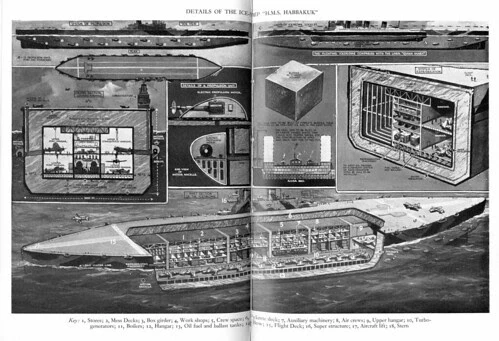
Project Habbakuk
"In future posts, as well as my home experiments, I will delve further into some of the fantastic personalities and myths behind Project Habbakuk, but here’s a brief introduction.
In 1942, the Allies were under attack by Axis forces in the Atlantic. They needed a way to improve the efficacy of their short-range aircraft, and started to look at ways to provide floating platforms to act as aircraft carriers in the North Atlantic.
Projecy Habbakuk was the brainchild of Geoffrey Pyke, an eccentric who had managed to get the ear of Lord Mountbatten and Winston Churchill. He proposed the construction of vast ships made of ice – its natural buoyancy would protect them from sinking in the event of enemy shelling, and the raw material (water) for their repair was virtually free. However, its brittleness and tendency to creep presented difficulties.
Pyke gained scientist J D Bernal’s support to develop the project. Bernal suggested his former student, Max Perutz, who had worked extensively on the properties of ice. Work was slow to start with, until Pyke sent Perutz a paper referring to the reinforcement of ice with microfibres derived from wood pulp. Tests on this material (given the name “Pykrete”, in honour of Geoffrey Pyke) were encouraging, and Perutz was set up in a lab in the cold stores below Smithfield Market in London.
Pykrete was dramatically stronger than ice and resistant to melting. Military chiefs were so impressed that they instigated a pilot project to build a model ship in Patricia Lake in Canada. The technical issues were extreme, however, and the cost of machinery needed to freeze the wood pulp and of iron for reinforcement of the bergship negated the cheapness of the raw materials. Furthermore, developments in aircraft design and deals made with the Portuguese to use the Azores for refuelling stations had effectively made the project redundant, and the model ship was scuttled in 1943."
https://project-habbakuk.blogspot.com/
keywords: habbakuk, seasteading
Researchers develop ice cube that doesn't melt or grow mold
"The researchers began working on the coolant cubes after Wang saw the amount of ice used at fish-processing plants and the cross-contamination that meltwater could spread among products or down the drain.
"The amount of ice used by these fish-processing sites is massive," Wang said. "We need to control the pathogens."
Sun also lamented mold found in the plastic ice packs used with school lunches for kids and frequently found in shipping packages.
Early tests have shown the cubes can withstand up to 22 pounds without losing form. They can be reused a dozen times—just a quick wash with water or diluted bleach—and then disposed of in the trash or with yard waste."
https://phys.org/news/2021-11-ice-cube-doesnt-mold.html
keywords: seasteading
Ice: The Penultimate Frontier
"Preventing a large iceberg from melting is absurdly cheap per unit area compared to just about any other way of making new land.
Space colonization on Mars costs hundreds of billions of dollars for a colony the size of a large apartment. Reclaiming land in shallow seas risks sovereignty disputes and in deep seas it requires large amounts of material or just the right type of shallow shoal which will have a limited area. Building a free-floating platform like an oil rig would not constitute a solid foundation and it would move up and down with the waves, and in any case would consume a large amount of quite expensive specialized concrete and other materials on a per-unit-area basis, especially if you want it to last for hundreds of years or more. Though I have to admit that just building a lot of floating oil-rig-type structures is also a far better deal than anything to do with space!
Ok, but how do you prevent an iceberg from melting? Easy - you insulate it as cheaply as possible. I have some ideas about how you might do this, but I am probably not quite able to pick the most optimal design on my first attempt. Still, we can at least give some lower bounds on how easy this should be."
https://substack.com/home/post/p-146562785
keywords: seasteading
Maine can’t do anything to stop the ‘floating camps’ popping up all over
"Floating camps are popping up more and more in Maine’s lakes, ponds and rivers.
These floating structures aren’t houseboats, and many don’t have motors at all. They resemble camps that you would see on shore, except they float, and are anchored to the bottom or tied to something onshore. They come with decks, planter boxes and second stories or vaulted ceilings.
Cool, right? Well, not exactly.
The state says the floating camps are blocking the views from houses and camps onshore, posing pollution risks, and creating congestion at public docks and boat ramps. Some are even being used as seasonal rental properties.
Because they are not solidly onshore, these camps are beyond the reach of private property boundaries and shore regulations that protect the water and fishery from pollution. And because Maine doesn’t have a clear definition of what is a boat and what isn’t, there’s no consensus of what regulations apply to the structures."
Bio-inspired Concrete
Concrete is an essential material in modern society. It is the second most used material after water and it’s demand continues to increase. However, at least 8% of global emissions caused by humans come from the cement industry. Therefore, reducing the environmental impact of cement and concrete production and use is critical in achieving a more sustainable environment. Biological systems are providing inspiration for solutions to this problem. In this episode, learn about two innovators that are developing materials that can reduce the environmental impact of construction.
This episode was sponsored by the Innovate UK Transforming Foundation Industries Challenge. This challenge is providing funding and support to create a cleaner, more efficient and more competitive sector that is fit for our future. Find out more by searching ‘Transforming Foundation Industries’ or going to this link.
Guests: Dr Lívia Riberio de Souza – CTO & Co-founder – Mimicrete Liv Anderson – CEO & Co-founder – BioZeroc
Thanks to Kolobyte and Alphabot for letting us use their music in the show!
If you have questions or feedback please send us emails at [email protected] or connect with us on social media: Instagram, Twitter.
Materialism Team: Taylor Sparks (co-creator,co-host), Andrew Falkowski (co-creator), Jared Duffy (production, marketing, and editing).
Keywords: UKRI, bio Inspired concrete, seasteading, podcastAcceleration Nation is a reader-supported publication. To receive new posts and support my work, consider becoming a free or paid subscriber.
Want to stay in touch? You can reach me in a variety of ways from my Contact page.