

It’s quite well known by now that, unique among economically developed countries, Israel’s TFR is robustly above replacement levels and shows no signs of dropping. Low and declining fertility across non-s**thole countries is a serious problem, threatening, at a minimum, chronic pension crises, and, in the most extreme cases, the actual extinction of ent…
Giliam de Carpentier's Carpentopod
Scott Alexander's 2021"Prospectus on Prospera"
"this post...[is all] the information I could collect on Próspera from basically every public source, plus some non-public ones. It's about a private tech city and a prosperity vision and all that. But it's also about - - - well, people talk a lot these days about “systemic change”. But usually that means something like fiddling with tax rates or ending the filibuster. What if you could actually change the system? Say "this system we have, the one that's letting all these people starve and suffer violence and die of preventable diseases - I don't care for it. Let's try something else"? Yes, this is about startup governments and investment opportunities and blah blah blah, but it's also about trying to fight global poverty by radically changing the rules of the game that makes it possible."
Scott Alexander recently responded at length to Garrison Lovely's hit-tweet on Próspera here:
https://x.com/slatestarcodex/status/1831405516326891549
Why is Israel one of the only developed countries with above-replacement fertility rate?
"The basic model here is that, unlike anywhere else in the world, there is no hard cultural barrier (at least in one direction) between Charedim and the rest of society, and enough mimetic stepping stones that almost everyone is influenced to some degree.
...
Is there anything the nations can learn from this to stop their societies falling apart?... set up high-fertility communities that are so cool those around them aspire to get close, but also have enough conviction in their own right to coolness that they never let the orbiters get close enough to influence them"
"There’s a severe kidney shortage. Should donors be compensated?"
More than 90,000 people in the U.S. are waiting for a kidney transplant. But an ongoing kidney shortage means a thousand people a month are removed from the waitlist, either because they die while waiting for a kidney or become too sick for a transplant.
Elaine Perlman wants to change that.
“Enough is enough,” she says. “The kidney shortage is a solvable problem.”
Perlman is executive director of Waitlist Zero, a coalition supporting newly proposed federal legislation that would create a 10-year pilot program called the End Kidney Deaths Act.
The bill, with sponsors from both parties, would offer a refundable tax credit of $50,000, spread evenly over five years, to people who donate one of their kidneys to an anonymous recipient on the national kidney waitlist.
Australia threatens fines for social media giants enabling misinformation
"Australia said it will fine internet platforms up to 5% of their global revenue for failing to prevent the spread of misinformation online, joining a worldwide push to rein in borderless tech giants but angering free speech advocates.
The government said it would make tech platforms set codes of
conduct governing how they stop dangerous falsehoods spreading, to be approved by a regulator. The regulator would set its own standard if a platform failed to do so, then fine companies for non-compliance.
The legislation, to be introduced in parliament on Thursday, targets false content that hurts election integrity or public health, calls for denouncing a group or injuring a person, or risks disrupting key infrastructure or emergency services."
Canadian government calls for $70 K fines, life imprisonment for "hate" speech.
https://tnc.news/2024/02/26/online-hate-bill-70k-fines-speech-and-life-imprisonment/
“New standalone hate crime offence that would apply to every offence in the Criminal Code and in any other Act of Parliament, allowing penalties up to life imprisonment to denounce and deter this hateful conduct as a crime in itself,” the technical briefing explained.
The bill would also raise “the maximum punishments for the four hate propaganda offences from 5 years to life imprisonment for advocating genocide and from 2 years to 5 years for the others when persecuted by way of indictment.”"
"Amendments to the Canadian Human Rights Act will let anybody file complaints against persons posting so-called hate speech with the Canadian Human Rights Commission. If found guilty, the Canadian Human Rights Tribunal can order those found to violate the government’s definition of hatred with fines up to $70,000 and takedown orders for content.
According to the text of the bill, the Tribunal has the power to order payments of up to $20,000 for victims of so-called online hate, as well as an order to pay the government $50,000 “if the member panel considers it appropriate.”"
Are Haitian's problems due to low IQ? Or due to some other factor?
GDP/capita of North Korea and Haiti are now about the same(~1500):
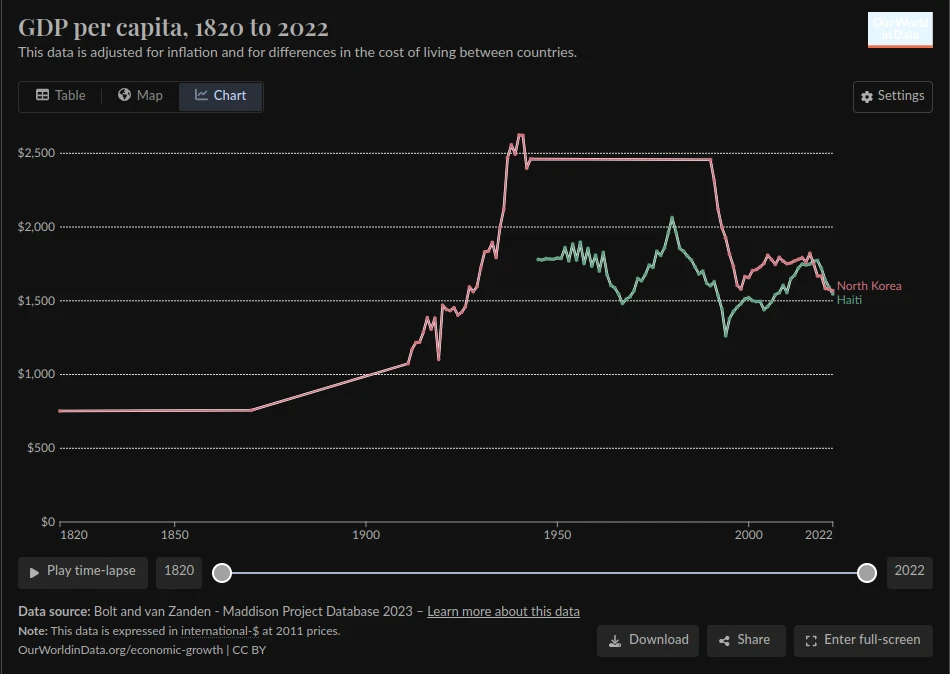
By contrast, the GDP of South Korea is 40 K/year. Despite originating from identical genetic stock, South Koreans have 27 times the GDP/capita of North Koreans. North Korea's poverty must not be due to IQ, but to poor governance.
However, instead of attributing Haitian poverty to poor governance, many attribute Haitian poverty to low IQ.
Is this a plausible explanation?
Haitians share half the island with the Domican Republic, who are largely derived from the same genetic stock and have similar IQ (82, according to this source):
https://worldpopulationreview.com/country-rankings/average-iq-by-country
Yet people in the Dominican Republic ($3,858) have 3 times the median household income as those in Haiti ($1,162).
https://worldpopulationreview.com/country-rankings/median-income-by-country
What about Haitians in the US?
"The median household income for Haitians in 2018 was lower than that of the overall foreign-born population, but higher than for Caribbean immigrant households. Haitian immigrant households had a median income of $53,800 in 2018, compared to $59,800 for foreign-born households and $49,400 for Caribbean households. For comparison, the median income for households headed by the native born was $62,300. "
Despite the fact that Haitians are coming from a poor country, and are non-native speakers, their poverty rate is only 1% higher than the native born:
"Haitians were about as likely to live in poverty as the overall immigrant population (14 percent compared to 15 percent) but slightly less likely than the Caribbean foreign-born population (16 percent). Thirteen percent of the U.S. born are in poverty."
https://migrationpolicy.org/article/haitian-immigrants-united-states-2018#Income
Of course, maybe the IQ of Haitians in the US is much higher than the IQ of Haitians in Haiti.
But if Haitian's were actually nearly clinically retarded, I would not have predicted that their income would increase so much when they move to the US.
How dangerous is it to live near Haitians?
The current murder rate in Haiti (per 100,000) is about 42. However, that's a sharp recent increase, likely due to the recent political turmoil. From 2010-2020, the murder rate in Haiti was ~10
https://statista.com/statistics/1040687/homicide-rate-haiti/
By contrast, the US murder rate looks to be around 6 for that same time period:
https://statista.com/chart/31062/us-homicide-rate/
Many US cities have a much higher murder rate than than Haiti did from 2010 - 2020:
https://en.wikipedia.org/wiki/List_of_United_States_cities_by_crime_rate
Philadelphia, for example, has a murder rate of 20.
Of course, maybe murders are being under-reported in Haiti. But if we're going to suppress immigration from Haiti, shouldn't we also suppress immigration from Philadelphia?
Want to stay in touch? You can reach me in a variety of ways from my Contact page.