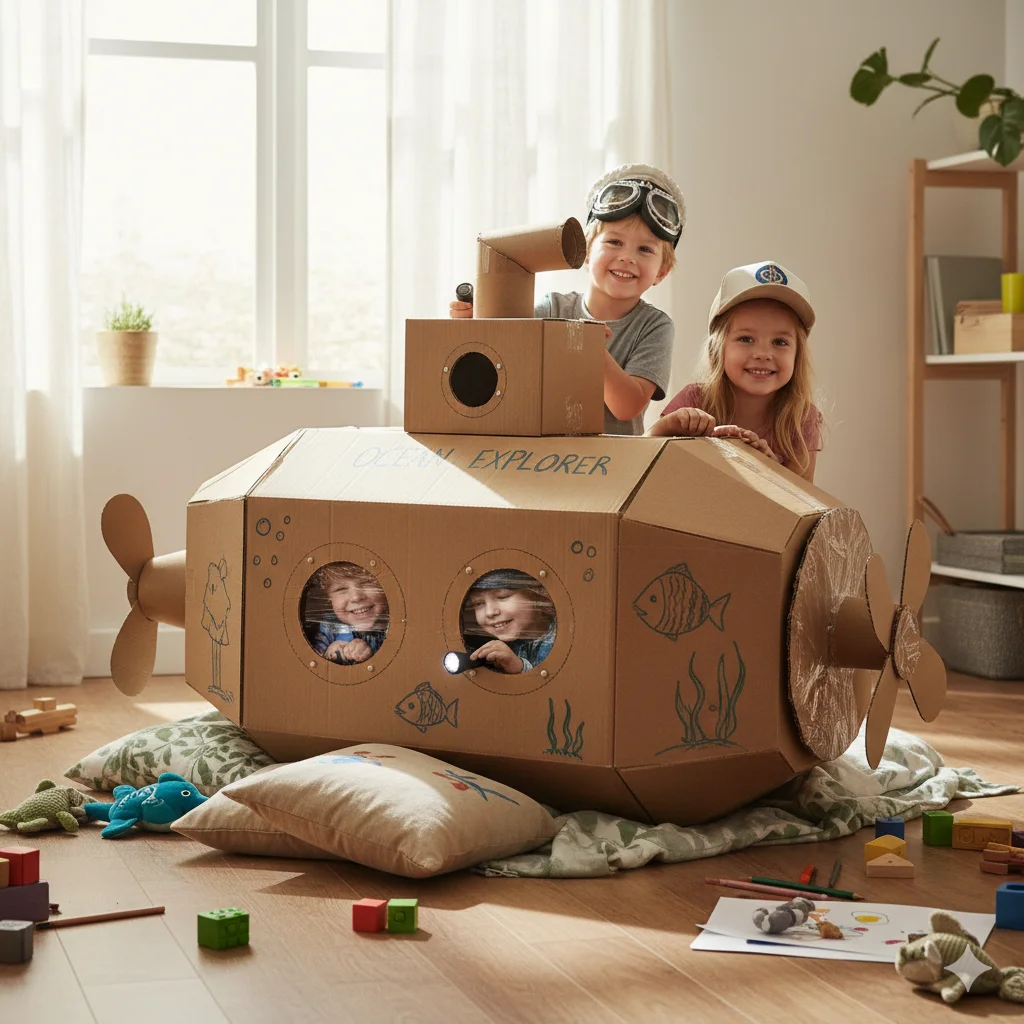
New seastead designs require a great deal of prototyping. Cardboard and paper mache are inexpensive, flexible, and strong materials well suited for mockups.
However, neither is especially waterproof.
This guide will cover a number of effective methods for waterproofing paper mache and cardboard:
Notes
The “best” method will depend on a variety of factors, such as how long you want the coating to last, how much water/sunlight/heat the item will have to endure, and your budget.
For example, some paper mache sculptures have survived continuous outdoor exposure with only a few coats of spar urethane for at least a year. Paper mache furniture made in the 18th century (but kept indoors) has survived to this day. Boats made of cardboard coated with elastomeric roof paint have lasted for a few years of regular use.
For really long lasting outdoors structures, the the coating should be a composite shell (epoxy fiberglass or industrial polyurea) that will hold its shape even if the paper deteriorates.
Plane for regular maintenance. You must re-coat, and make repairs following damage due to animals/insects/mold.
Build a up multiple layers. Apply multiple thin coats rather than one thick coat for best results.
When laminating multiple layers, alternate the direction of corrugation to increase strength.
Periodically refresh the coating.
Avoid any features which will trap water.
Design weep holes and vents to allow moisure to escape
Heavily reinforce all edges. Seal edges and seams thoroughly to prevent water ingress.
Consider adding vents or weep holes so any moisture that does get in can get out.
will.Wheat paste is inexpensive, non-toxic, and easy to make. Use wheat paste to glue sheets together, fill in gaps and edges, and harden surfaces. However, wheatpaste s not waterproof. You must coat it with another waterproof sealant to prevent degradation from water, mold, and insects.
Always allow coatings to dry and cure fully before moisture exposure.Handle all chemicals and hot materials with proper safety precautions.
Additives:
Several additives can improve the performance of the coatings:
Lamp Black (Carbon Black): Adds UV protection and opacity.
Metal Stearate: Improves water resistance, flow, and UV stability. Can be made by reacting stearic acid with lye to produce a powder for mixing into coatings.
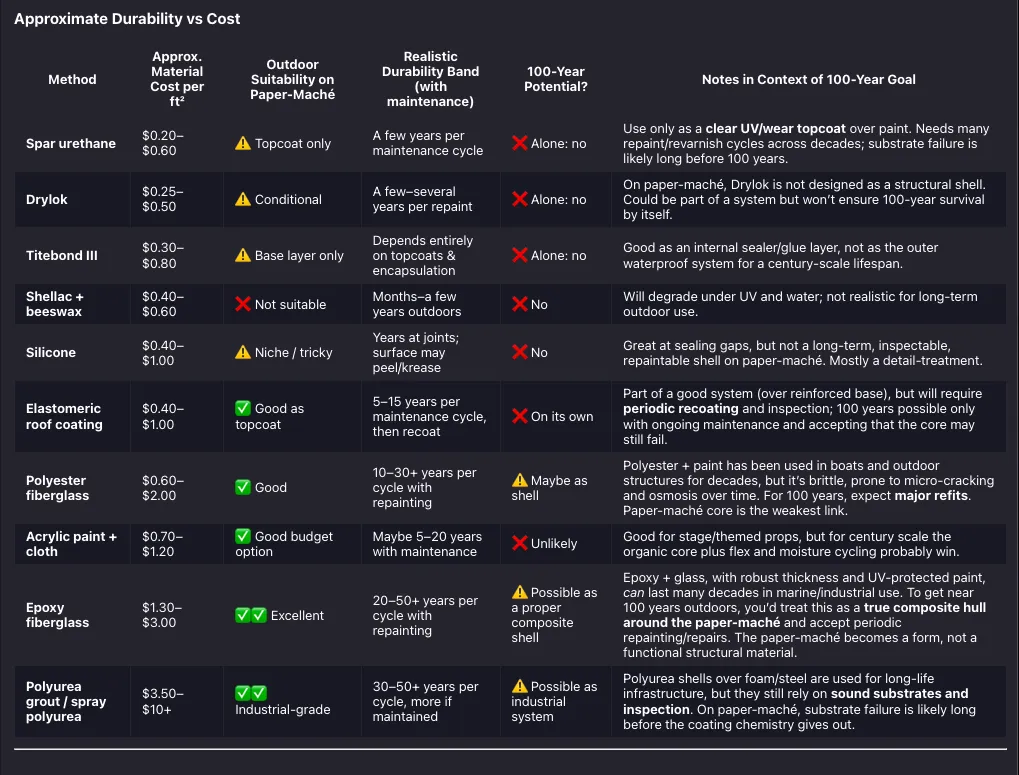
Summary of waterproofing methods
Notes
Spar urethane
Approx. material cost per ft²: $0.20–$0.60
Outdoor suitability on paper‑maché: ⚠️ Topcoat only
Realistic durability band (with maintenance): A few years per maintenance cycle
100‑year potential?: ❌ Alone: no
Notes in context of 100‑year goal: Use only as a clear UV/wear topcoat over paint. Needs many repaint/revarnish cycles across decades; substrate failure is likely long before 100 years.
Drylok
Approx. material cost per ft²: $0.25–$0.50
Outdoor suitability on paper‑maché: ⚠️ Conditional
Realistic durability band (with maintenance): A few–several years per repaint
100‑year potential?: ❌ Alone: no
Notes in context of 100‑year goal: On paper‑maché, Drylok is not designed as a structural shell. Could be part of a system but won’t ensure 100‑year survival by itself.
Titebond III
Approx. material cost per ft²: $0.30–$0.80
Outdoor suitability on paper‑maché: ⚠️ Base layer only
Realistic durability band (with maintenance): Depends entirely on topcoats & encapsulation
100‑year potential?: ❌ Alone: no
Notes in context of 100‑year goal: Good as an internal sealer/glue layer, not as the outer waterproof system for a century‑scale lifespan.
Shellac + beeswax
Approx. material cost per ft²: $0.40–$0.60
Outdoor suitability on paper‑maché: ❌ Not suitable
Realistic durability band (with maintenance): Months–a few years outdoors
100‑year potential?: ❌ No
Notes in context of 100‑year goal: Will degrade under UV and water; not realistic for long‑term outdoor use.
Silicone
Approx. material cost per ft²: $0.40–$1.00
Outdoor suitability on paper‑maché: ⚠️ Niche / tricky
Realistic durability band (with maintenance): Years at joints; surface may peel/krease
100‑year potential?: ❌ No
Notes in context of 100‑year goal: Great at sealing gaps, but not a long‑term, inspectable, repaintable shell on paper‑maché. Mostly a detail‑treatment.
Elastomeric roof coating
Approx. material cost per ft²: $0.40–$1.00
Outdoor suitability on paper‑maché: ✅ Good as topcoat
Realistic durability band (with maintenance): 5–15 years per maintenance cycle, then recoat
100‑year potential?: ❌ On its own
Notes in context of 100‑year goal: Part of a good system (over reinforced base), but will require periodic recoating and inspection; 100 years possible only with ongoing maintenance and accepting that the core may still fail.
Polyester fiberglass
Approx. material cost per ft²: $0.60–$2.00
Outdoor suitability on paper‑maché: ✅ Good
Realistic durability band (with maintenance): 10–30+ years per cycle with repainting
100‑year potential?: ⚠️ Maybe as shell
Notes in context of 100‑year goal: Polyester + paint has been used in boats and outdoor structures for decades, but it’s brittle, prone to micro‑cracking and osmosis over time. For 100 years, expect major refits. Paper‑maché core is the weakest link.
Acrylic paint + cloth
Approx. material cost per ft²: $0.70–$1.20
Outdoor suitability on paper‑maché: ✅ Good budget option
Realistic durability band (with maintenance): Maybe 5–20 years with maintenance
100‑year potential?: ❌ Unlikely
Notes in context of 100‑year goal: Good for stage/themed props, but for century scale the organic core plus flex and moisture cycling probably win.
Epoxy fiberglass
Approx. material cost per ft²: $1.30–$3.00
Outdoor suitability on paper‑maché: ✅✅ Excellent
Realistic durability band (with maintenance): 20–50+ years per cycle with repainting
100‑year potential?: ⚠️ Possible as a proper composite shell
Notes in context of 100‑year goal: Epoxy + glass, with robust thickness and UV‑protected paint, can last many decades in marine/industrial use. To get near 100 years outdoors, you’d treat this as a true composite hull around the paper‑maché and accept periodic repainting/repairs. The paper‑maché becomes a form, not a functional structural material.
Polyurea grout / spray polyurea
Approx. material cost per ft²: $3.50–$10+
Outdoor suitability on paper‑maché: ✅✅ Industrial‑grade
Realistic durability band (with maintenance): 30–50+ years per cycle, more if maintained
100‑year potential?: ⚠️ Possible as industrial system
Notes in context of 100‑year goal: Polyurea shells over foam/steel are used for long‑life infrastructure, but they still rely on sound substrates and inspection. On paper‑maché, substrate failure is likely long before the coating chemistry gives out.
Method 1: Biodegradable Shellac and Beeswax Waterproofing
▶ Watch on YouTube
has developed several recipes for waterproofing various materials, including cardboard and paper mache. This section covers a method based on covering the object with non-toxic, biodegradable shellac & beeswax mixture.
Method 1: Biodegradable Shellac and Beeswax Waterproofing
Materials:
isopropyl alcohol - 0.5 L
shellac flakes - 125 g
beeswax - 15 g
calcium stearate - 2 g (optional, for better water and UV resistance)
Tools:
wooden spoon
Preparation:
In a well-ventilated area away from flames, combine shellac flakes with isopropyl alcohol in a sealable container.
Let the shellac flakes dissolve completely, stirring occasionally.
Melt beeswax gently using low heat until liquid.
Slowly mix the melted beeswax into the shellac-alcohol solution, stirring thoroughly.
Add a small amount of metal stearate powder to improve water repellency and UV resistance, then stir well.
Application:
Use a brush or roller to apply evenly on cardboard.
Focus on edges, seams, and cut areas for full coverage.
Apply multiple thin coats, letting each dry fully before the next.
Allow the final coat to cure completely before exposing to water or outdoors.
Safety:
- Isopropyl alcohol is highly flammable — work in a ventilated space away from sparks or flames.
Method 2: Hot Glue and Paraffin Wax Waterproofing
Another
▶ Watch on YouTube
recipe. This one is non-toxic but not biodegradable.
Materials:
mineral oil (small amount)
Optional: lamp black or calcium stearate for UV resistance
Preparation:
Heat hot glue sticks and paraffin wax together until fully melted and blended.
Add a small amount of mineral oil to improve flow and lower melting point.
Optionally, mix in additives like lamp black or metal stearate for durability.
Application:
While hot, apply the mixture with a brush or similar tool.
Use thin, even coats rather than thick layers for flexibility and adhesion.
Apply multiple coats, letting each cool and solidify before the next.
Can also be used to waterproof fabric by impregnation.
Notes:
This method is not biodegradable.
The cured coating can be burned as fuel if disposal is needed.
Want to stay in touch? You can reach me in a variety of ways from my Contact page.