

In this episode, we dive deep into the recent changes in YouTube’s moderation policies and the impact of AI (specifically Gemini) on content creators. We discuss our own experience with video takedowns, the challenges of addressing controversial topics, and the shifting landscape of online discourse…
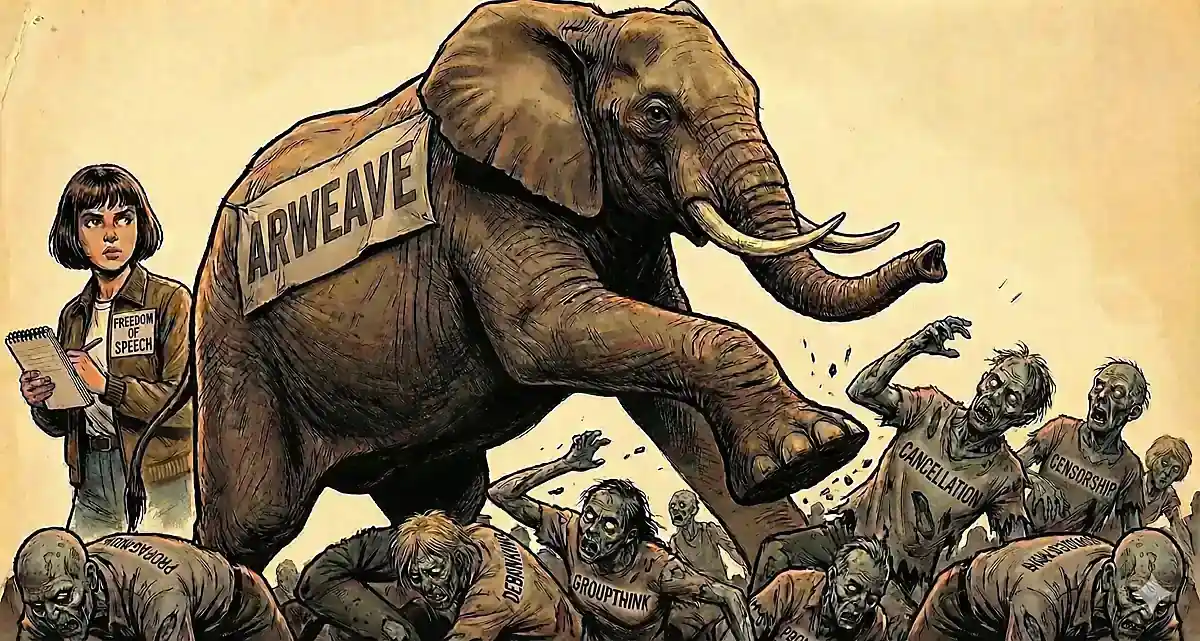
When One Strike Threatens Your Life’s Work
Imagine you’re a YouTube creator.
You’ve spent years and hundreds of hours creating regular videos.
Your efforts have paid off, and you now have 50,000+ viewers subscribed to your channel.
Now imagine waking up to find your entire YouTube channel demonetized or deleted, all because Google’s new AI moderator, Gemini, disliked some of your videos.
That’s the risk that Malcolm and Simone Collins of the Based Camp podcast [1] are facing.
Gemini took down their video: Hitler Was A Hipster (In Literally Every Way Possible), and gave the channel a strike.
The video critiqued Hitler as a “failed artist, a hipster, a vegetarian, an environmentalist” with leftist influences (e.g., Theosophical society ties), arguing against idolizing him among right-leaning young men.
It positioned Nazis as socialists, citing Hitler’s quotes like “We are socialists... We are the enemies of today’s capitalistic economic system” and policies such as industry nationalization.
The Collins say that Gemini struck the video for the following violations:
Harassment/cyberbullying: Use of the R-word (retard) in reference to mentally disadvantaged people, deemed “prolonged name calling... based on protected attributes including disability.”
Hate speech/dehumanization/generalizations: Statements like “everyone knows leftists are racist... The left dear has always been the party of antisemitism,” supported by historical examples (e.g., antisemitism in Karl Marx, Joseph Stalin, Pierre Joseph Proudhon). Flagged as broad attacks on leftists.
Holocaust denial/distortion: Claims of historical revisionism for labeling Nazis socialists (via “National Socialist German Workers Party”), equating fascism to socialism, and phrases like “real fascism has never been tried.”
Association with banned figures: Negative mention of Nick Fuentes, despite context being critical.
Appeals to YouTube failed; Gemini upheld the decision.
A strike is the first step in a process that could result in their entire channel being deleted:
First Strike: Week-long channel takedown.
Second Strike: Months-long takedown.
Third Strike: Permanent deletion of all videos.
As a number of other creators have discovered, Based Camp’s audience and archive exist wholly at YouTube’s pleasure.
YouTube’s rules change quickly.
Initial enforcement is almost entirely automated.
Appeals are difficult and often futile.
One or two misclassifications can jeopardize your channel and income.
Demonetization and Censorship
Simone and Malcolm Collins’ experience is not uncommon. Here are several additional examples of YouTube channels being censored for posting truthful information.
1. Firearms Education: Hickok45
Hickok45 is one of YouTube’s biggest gun channels, focused on firearms reviews, safety, and historical commentary. In 2016, his channel briefly disappeared—twice—after violations related to YouTube’s firearms policies. The episodes reportedly involved standard reviews and demonstrations, not crime instruction or incitement.
YouTube later restored the channel, calling the removals a mistake. But from the creator’s side, the lesson was clear: an automated or misinterpreted policy hit could revoke millions of subscribers and thousands of videos overnight. The content itself didn’t suddenly become more or less dangerous; what changed was an internal threshold.
Channel: Hickok45 on YouTube
2. Sex Work & Policy Discussion: Sunny Megatron / Sex‑Ed Creators
Sex‑educator channels have been repeatedly censored.
For example, Sunny Megatron, a sex educator, has had a number of videos age‑restricted or demonetized despite avoiding explicit nudity or acts, simply for covering BDSM, consent, or kink education in a factual way. Other educators and sex‑worker advocates report similar outcomes: non‑explicit interviews, legal information, or safety advice flagged as “adult content.”
The stated rationale is consistent: keep the platform family‑friendly and advertisers comfortable. The impact is that even factual, harm‑reduction content gets lumped in with porn. Income drops to near zero, recommendations dry up, and creators either self‑censor or relocate.
Website: [suspicious link removed]
YouTube: Sunny Megatron on YouTube
3. John Ioannidis Video (2020): Questioning Lockdown Damage
In 2020, Stanford professor John Ioannidis appeared in videos discussing COVID‑19 data, infection fatality rates, and the potential harms of broad lockdowns [2]. One of these uploads, which questioned the proportionality of lockdown policies based on emerging data, was removed by YouTube for contradicting guidance from health authorities.
The stated rationale was to combat medical misinformation. Yet Ioannidis’s core point—that fatality risk was highly stratified and that blanket lockdowns had serious costs—aligned increasingly with later discussions in mainstream outlets as more data came in. The content was statistical and cautious, but it fell on the wrong side of the policy line at the time.
Profile: John P. A. Ioannidis – Stanford Medicine
4. Rand Paul Mask Video (2021): Cloth vs N95
In 2021, YouTube removed a video from Senator Rand Paul’s channel in which he questioned the efficacy of cloth masks and argued for the superiority of N95‑type respirators [3]. The clip was taken down under COVID‑19 medical‑misinformation policies because it conflicted with then‑current CDC messaging.
Ironically, Paul’s argument—that cloth masks offer limited protection compared to fitted N95s—mirrored prior statements by health officials and, later, more nuanced guidance emphasizing respirators in high‑risk settings.
Senate page: Senator Rand Paul
YouTube: Rand Paul on YouTube
5. Lab‑Leak Theory Videos (2020–2021): From “Misinformation” to “Plausible”
Throughout 2020 and into 2021, many videos discussing the lab‑leak hypothesis for COVID’s origins were removed or suppressed under misinformation rules. These videos ranged from speculative to careful forensic analysis. The blanket treatment labeled lab‑leak talk as fringe or harmful.
Over time, multiple intelligence agencies and mainstream outlets acknowledged lab leak as a plausible theory, with no definitive disproof and some suggestive evidence. Yet the enforcement history on YouTube often treated early discussion as verboten, despite the underlying question being scientific and unresolved rather than inherently false.
6. Memory Holed Series (2022): Skyler Orfalea’s Election Montages
In 2022, journalist Skyler Orfalea published a Memory Holed video series compiling factual, on‑record clips: Democrats alleging fraud or “hacked” votes around the 2016 election, alongside Republicans claiming irregularities in 2020. The editing was straight montage—no deepfakes, no fabricated quotes—intended to document double standards in rhetoric.
YouTube demonetized or removed some of these videos for “advancing false claims” about elections, even though the clips themselves were archival footage of prominent politicians and commentators. The stated rationale was civic‑integrity enforcement; the impact was that a piece of balanced, historical reporting—with both sides’ claims presented—was treated as if it were endorsing those claims.
YouTube channel: Skyler Orfa – Memory Holed (channel hosting Memory Holed content)
What can creators do to prevent such censorship?
Many writers and podcasters have moved to Substack.
Unlike YouTube and most other social media firms, Substack doesn’t currently try to lock in their users by cutting off creators from independent access to their users. Substack allows creators to export, back up, and move their users’ email list to a CSV File.
If Substack bans you, you can take your audience elsewhere.
However, Substack’s policies could change at any time.
Many other social media firms were permissive at first, but gradually locked creators out of all access to their users (so they could sell access to advertisers and the creators themselves).
Moreover, all other social media firms have become increasingly censorious over time.
While Substack’s policies are significantly less overbearing than the policies of YouTube, they have already taken down users and banned essayists in the past.
Even if the creator can relocate their content elsewhere, it’s still a big time and energy sink.
Substack is a good alternative to YouTube, but Arweave/Odysee offer an alternative that would make censorship difficult even by the Arweave/Odysee devs themselves.
Arweave’s Origin Story
If Bitcoin’s founding trauma is “central banks can debase your money,” Arweave’s is closer to “regimes and corporations can erase your history.”
Arweave was founded by Sam Williams, a computer scientist who noticed growth of censorship by NGOs, big tech firms, and governments [4].
For example, on YouTube:
Videos live on Google‑controlled servers.
Access is mediated by Google’s apps, APIs, and recommendation engine.
A relatively small group of employees, plus automated systems, can:
- Remove individual videos.
- Demonetize whole categories.
- Throttle recommendations.
- Delete or lock your entire channel.
- Remove individual videos.
Williams wondered: what would it take to make a permanent, censorship-resistant archive of humanity’s data?
In particular, he wanted:
Censorship resistance: No more news articles disappearing from state archives, inconvenient reports quietly retracted, or videos taken down by government order.
Tamper resistance: No more secret tampering of primary sources, scientific data, or newspaper articles.
Permanence: All data, once committed, is practically very hard to delete—no “oops, we changed the policy” button.
Thus Sam and friends launched the Arweave project to achieve these goals in 2017.
The Arweave spec aims to store user data in a decentralized, censorship resistant manner for 200+ years for a one-time fee.
And it has been popular! The Arweave network has grown substantially since its founding:
Arweave now stores roughly 15% of the indexed web (~0.3 petabyte).
As of November 2025, the AR.IO network (which manages the primary registry of gateways for the Arweave ecosystem) reports just under 700 gateways.
There have been over 7 billion storage transactions as of July 2024.
Arweave: Storage You Don’t Control, But Neither Does Any One Gatekeeper
How does Arweave achieve its objectives?
A novel storage network they call the blockweave
A conservative economic model with a huge safety margin.
With the blockweave system, miners don’t just store the latest block; they must prove access to random pieces of historical data. This design makes it economically rational to keep old data around, not just recent transactions.
Data (web pages, PDFs, video chunks, and more) is stored across many independent nodes. Each piece of data is identified by a TXID (transaction ID) / content hash.
Individual node operators or gateways can choose not to serve specific content.
A government can pressure or block particular gateways.
But there is no single “admin console” that can issue a global delete. As long as some nodes store the data and some gateways serve it, that content exists and is addressable.
Odysee: A Door, Not A Vault
Odysee [5] acts as a user friendly entrance to the data stored on the Arweave network.
It offers YouTube‑like interface with channels, comments, and discovery and monetization tools.
Odysee can still:
Moderate listings.
Ban users.
Alter its recommendation and monetization policies.
But being banned from Odysee doesn’t erase the underlying data.
You lose access to the Odysee interface, not your access to the data stored in the Arweave vault.
On YouTube, getting banned often means your work is gone from public access unless you have independent backups elsewhere.
On an Odysee‑plus‑Arweave stack, you can:
Point people to alternative gateways.
Rebuild a front‑end elsewhere.
Prove your content hasn’t been tampered with via TXIDs and hashes.
How Can Arweave Provide 200+ Years of Storage?
Instead of charging you monthly hosting fees, Arweave uses an endowment model:
You pay a one‑time fee to store data.
That fee goes to:
- Pay miners now.
- Build a pool of value that can continue incentivizing storage as hardware gets cheaper.
- Pay miners now.
The bet is basically:
Storage costs have fallen dramatically for decades [6].
If that trend continues, a finite amount of money today can cover a very long time horizon.
SPoRA: Proving You Actually Store Old Stuff
Arweave uses SPoRA (Succinct Proofs of Random Access) to keep miners honest:
When mining new blocks, miners must prove they can retrieve random chunks of historical data.
If they don’t store old data, they can’t reliably produce those proofs.
Failing to prove means failing to earn rewards.
In practice:
The cheapest way to keep getting paid is to store the data.
Deleting large spans of history is economically irrational for miners who want a steady income.
You get a system where “keep the archive alive” is the equilibrium strategy, not an act of charity.
How Does Arweave Mitigate Risks?
There are many potential risks to the Arweave network, such as:
What if the price of Arweave’s token collapses?
What if usage dries up?
What if storage stops getting cheaper?
What if the arweave.net or odysee.com domains are blocked, seized, or sold?
What if the Arweave/Odysee devs are imprisoned?
What if the company that founded the Arweave network goes bankrupt?
How does the Arweave network mitigate these risks?
It’s important to note there is no cosmic guarantee of success—the Arweave network could fail at some point.
However, the devs have built in several features that help ensure that the data will be stored for at least 200 years.
Storage Costs
Arweave bakes in a very conservative safety margin in its economic model:
Historically, the cost of storage (per GB‑hour) has fallen ~30–38% per year over ~50 years (Kryder’s Law).
In contrast, Arweave’s endowment model assumes only a –0.5% per year decline in storage costs when calculating how long the endowment can pay for storage.
That’s a safety factor of ~60–70× between the historical trend and the assumption used to guarantee “200+ years” of storage.
Users pay a one‑time fee that is modeled to cover ~200 years of storage at today’s prices.
Only ~5% of that fee goes to miners immediately; ~95% goes into the storage endowment to be dripped out over time.
So the protocol is intentionally overcharging relative to expected long‑run costs to build a buffer:
If storage costs never fall again, the endowment for today’s upload would be exhausted in ~200 years.
If storage costs fall even 0.5%/year, the endowment is mathematically never exhausted; payouts shrink as storage gets cheaper.
At historical –30%+ per year declines, most of the endowment tokens should never need to be reissued, effectively making them permanently out of circulation.
Conservative Design Choices That Add Effective Safety
For every uploaded file, at least 20+ replicas are stored across at least ~20 independent nodes, so availability doesn’t depend on a single provider. Many independent actors can store copies, including:
- Open‑source archivists.
- Institutions who value long‑term data.
- Projects whose own survival depends on that data.
The endowment only pays when needed. If miners are already profitable from inflationary block rewards plus immediate transaction fees, no endowment payouts happen, leaving more tokens in reserve for the future.
Nearly seven years in, there’s been no reissue from the endowment at all; usage has only added tokens to it.
When Gateways Fall
On YouTube, if google shuts down your account or ends the Youtube service you have no recourse.
By contrast, Arweave runs on open source software and is served through multiple gateways.
Gateways:
Speak Arweave’s protocol to fetch data.
Expose it via ordinary HTTPS URLs.
Anyone can:
- Run a node or gateway.
- Mirror data.
- Build migration tools to move stored content onto a successor system if needed.
That way, if one gateway:
Gets seized.
Geoblocks your region.
Changes its moderation policies.
You can switch to another gateway that still serves the same TXIDs. It’s like having multiple mirrors for the same file, not just one proprietary CDN.
Self‑Hosted Gateways and Nodes
In the worst‑case scenario that all of the existing Arweave gateways are shut down (highly unlikely) you can:
Run your own Arweave node.
Deploy your own gateway that:
- Stores your critical content.
- Serves it under your own domain.
- Stores your critical content.
Raw TXIDs as the Ultimate Pointer
Each piece of data on Arweave is addressed by:
- A Transaction ID (TXID) or content hash.
If you have that identifier, and any functioning gateway or client, you can:
Retrieve the content.
Verify it hasn’t changed.
The Arweave equivalent of a “permalink” isn’t site.com/video123; it’s the TXID itself. Front‑ends come and go. The TXID is the anchor.
Current Arweave costs?
ResSize (1 hr)Typ. SizeCost (1x)Typ. Cost720p1–3 GB~1.5 GB$6–$12~$91080p2–4 GB~3 GB$8–$48~$184K8–20 GB~12 GB$30–$240~$72
Notes:
File sizes assume H.264 compression at reasonable consumer‑grade bitrates.
Cost range reflects a rough $4–$12/GB band; actual Arweave pricing is dynamic.
“Typical Cost” uses the midpoint of the typical size at ~$6/GB.
Verify current costs via ar-fees.arweave.net or arweavefees.com before publishing.
You can get the current price via official tools like arweave.net/price or arweavefees.com before publishing.
Making a Living: Odysee’s Monetization Stack
Odysee offers creators several monetization tools:
Viewers can send tips in AR.
Viewers can pay one‑time unlock fees.
Viewers can pay recurring membership fees.
See Odysee’s docs for details on how to start accepting payments: Odysee Monetization Help
Discovery on Odysee
YouTube’s recommendation engine helps drive viewers to creator channels. How can people find you on Odysee?
Keyword search and tags – Users search directly for topics, names, or shows.
Channel subscriptions – Once someone subscribes, they see your new uploads in a predictable feed.
Recommendations / related content – Odysee’s recommendation mechanism.
Community curation – Playlists, reposts, and (in some designs) staking/boosting mechanisms where users can pay or pledge to surface content.
Tradeoffs
There are several tradeoffs to using Odysee rather than Youtube. These include:
Less algorithmic lottery – You’re less likely to get a 10‑million‑view spike.
Less algorithmic punishment – You’re also less likely to vanish because a classifier decided your niche is “brand unsafe.”
More intentional audiences – Traffic is driven more by search, shares, and loyal subscribers than by autoplay roulette.
For creators who already rely on email lists, Telegram channels, or RSS, this model is familiar: build a base, then give them stable ways to reach you.
Odysee won’t solve “top of funnel” for you the way YouTube sometimes does, but it’s also less likely to rug‑pull you once you’ve done the hard work.
How To Upload Video To Odysee
1. Log in to your account and click the cloud icon with an upward arrow located in the top right corner of the interface, next to the search bar. Select Upload from the dropdown menu.
2. Click the Browse button or drag and drop your video file into the upload area. While many formats are supported, MP4 (H.264/AAC) is recommended for optimal compatibility across devices.
3. Provide a title, description, and a custom URL slug. You can also upload a thumbnail or provide a direct image link.
4. Add up to 5 tags to help users discover your content. Ensure you select the correct channel from your list if you manage multiple identities.
5. Click the Upload or Save button at the bottom of the page. The video will undergo processing and will appear on your channel once finalized.
Alternative: YouTube Sync
1. If you are a creator with an existing YouTube audience, you can utilize the Odysee Sync tool. This feature automatically mirrors your YouTube uploads to your Odysee channel.
2. To qualify, your YouTube channel generally needs at least 100 subscribers. This method handles all metadata and file transfers automatically, ensuring your decentralized library stays up to date without manual intervention.
How Retrieve Your Videos Independent Of Odysee
Arweave functions as a permanent, append-only data store where every piece of data is assigned a unique, immutable hash that serves as its permanent address. This is called the Transaction ID.
To retrieve a video on the Arweave network independent of Odysee or other gateways, you must find the specific Transaction ID associated with the file.
Arweave transactions are often bundled. Bundling is when many smaller files (like short clips) are grouped together to save on gas and improve network efficiency. So it may take anywhere from a few hours to several days for the Transaction IDs to appear on the Arweave network for new Odysee content.
The simplest way to find the TXID is through the Odysee web interface itself:
1. Open the video at the provided URL.
2. Click the Share button located beneath the video player.
3. Look for a link labeled Permaweb, Arweave, or a 43-character string (the TXID). If available, this link will direct you to an Arweave gateway (e.g., arweave.net/TXID).
Note that Odysee is currently transitioning from a deprecated token system (LBRY) to the Arweave network, so they not yet implemented this yet.
References
[1] Collins, M. & Collins, S. We may have to shut down the channel. Based Camp Substack. 2024. This post details the specific strikes and potential platform migration facing the creators after AI-driven content moderation.

[2] Ioannidis, J. P. A. A fiasco in the making? As the coronavirus pandemic takes hold, we are making decisions without reliable data. STAT News. 2020. This article captures the early scientific skepticism regarding lockdown efficacy that led to content moderation on major platforms. https://www.statnews.com/2020/03/17/a-fiasco-in-the-making-as-the-coronavirus-pandemic-takes-hold-we-are-making-decisions-without-reliable-data/
[3] Paul, R. Resisting the Great Reset. Senate.gov. 2021. This record documents the Senator’s statements on respiratory protection and masking that were subject to platform removal. https://www.paul.senate.gov/news/sen-rand-paul-introduces-bill-to-end-mask-mandates-on-public-transportation/
[4] Arweave Team. Arweave: A Protocol for Economically Sustainable Information Permanence. Arweave Project. 2023. The whitepaper outlines the SPoRA consensus mechanism and the endowment-based economic model ensuring multi-century storage. https://www.arweave.org/yellow-paper.pdf
[5] LBRY Foundation. Odysee Help: Monetization and Uploads. LBRY Documentation. 2024. This resource explains the technical transition from LBRY to Arweave and how creators can manage discovery and revenue.
[6] Walter, C. Kryder’s Law. Scientific American. 2005. This article discusses the historical trend of increasing magnetic disk storage density and the corresponding drop in costs over time. https://www.scientificamerican.com/article/kryders-law/
Want to stay in touch?
Join my Signal announce-only group to be notified when I have a new essay up and other important announcements.
For discussion, join the libertygardeners Signal group.
Subscribe to my mailing list.
Email: [email protected]
Signal: archerships.43
Other social media:
Want to stay in touch? You can reach me in a variety of ways from my Contact page.