From the "why you want financial privacy" files:
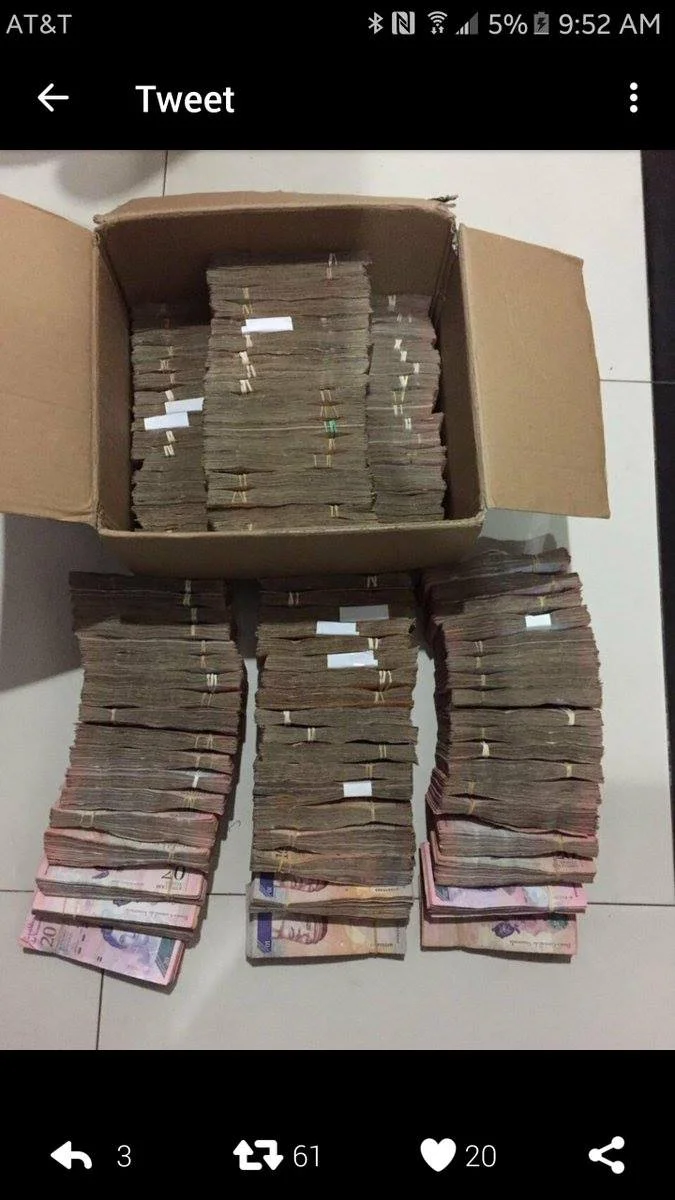
* The Venezuelan currency has been so devalued that shopkeepers now just weigh the bills. (5) See attached photo of $30 in Venezuelan bolivars.
* The Indian government has sparked riots by demonetizing all existing Rs 500 and Rs 1,000 notes (roughly equivalent to $10 and $20 bills). (2)
* India has declared that they will tax all undeclared gold at an 85% tax rate. The government promises that it won't seize inherited jewelry, nor gold up to 500 g/married woman, 250 g/unmarried woman, and 200 g/man. However, the burden of proof is on Indian citizens to prove that the gold was "legitimately" acquired. (3)
Think this kind of hyperinflation/confiscation can't happen in the US?
* According to Vincent Cate's hyperinflation FAQ:
"Bernholz did a study of 29 cases of hyperinflation and looked at the circumstances that led up to them. He found that the best predictor of hyperinflation is government debt over 80% of GNP and the deficit over 40% of government spending, in a country that prints its own money. Note that 50% deficit spending would mean spending twice what was collected in taxes. The US is over the debt number and not far from the deficit number, so the danger of hyperinflation is real." (7)
* When FDR devalued the dollar in 1934, he issued Executive Order 6102, which criminalized the private possession of monetary gold in amounts over 5 troy ounces (160 g), worth about $6300 in today's dollars. Violation of the order was punishable by a fine up to $10,000 (equivalent to $183,111 today) or up to ten years in prison, or both. This order remained in effect until December 31, 1974. (9)
* Unless you declare it on a “Shipper’s Export Declaration Form", customs agents are authorized to seize any commodity transported in or out of the US valued at $2,500 or more. You may be also be fined up to $10,000 and/or imprisoned. (4)
* Financial institutions are required to collect identification for all of their customers ("Know Your Customer" laws), and report all transactions over $10,000. Smaller transactions must also be reported, if the financial institution deems them "suspicious". (8)
* The IRS has demanded that Coinbase (the most popular bitcoin exchange) turn over all of their customer's records. Although Coinbase is fighting it, it's by no means clear that they will win. We also don't know what secret National Security Letters Coinbase and other centralized exchanges have received. (1)
1. https://www.techdirt.com/articles/20161118/18090136088/irs-demands-all-info-all-coinbase-customers.shtml
2. http://timesofindia.indiatimes.com/city/bareilly/Unrest-erupts-in-UP-towns-as-cashless-crowds-vent-ire-on-bank-staff/articleshow/55528509.cms
3. http://indiatoday.intoday.in/story/gold-jewellery-married-lady-income-tax-raids-demonetisation/1/824321.html
4. http://www.financialsense.com/contributors/mark-nestmann/understand-rules-before-you-transport-precious-metals-overseas-part-ii
5. https://www.bloomberg.com/news/articles/2016-10-31/tired-of-counting-piles-of-cash-venezuelans-start-weighing-them
6. https://www.aclu.org/report/financial-privacy-reporting-requirements-under-bank-secrecy-act
7. http://howfiatdies.blogspot.com/2012/10/faq-for-hyperinflation-skeptics.html
8. https://en.wikipedia.org/wiki/Know_your_customer
9. https://en.wikipedia.org/wiki/Executive_Order_6102
* The Venezuelan currency has been so devalued that shopkeepers now just weigh the bills. (5) See attached photo of $30 in Venezuelan bolivars.
* The Indian government has sparked riots by demonetizing all existing Rs 500 and Rs 1,000 notes (roughly equivalent to $10 and $20 bills). (2)
* India has declared that they will tax all undeclared gold at an 85% tax rate. The government promises that it won't seize inherited jewelry, nor gold up to 500 g/married woman, 250 g/unmarried woman, and 200 g/man. However, the burden of proof is on Indian citizens to prove that the gold was "legitimately" acquired. (3)
Think this kind of hyperinflation/confiscation can't happen in the US?
* According to Vincent Cate's hyperinflation FAQ:
"Bernholz did a study of 29 cases of hyperinflation and looked at the circumstances that led up to them. He found that the best predictor of hyperinflation is government debt over 80% of GNP and the deficit over 40% of government spending, in a country that prints its own money. Note that 50% deficit spending would mean spending twice what was collected in taxes. The US is over the debt number and not far from the deficit number, so the danger of hyperinflation is real." (7)
* When FDR devalued the dollar in 1934, he issued Executive Order 6102, which criminalized the private possession of monetary gold in amounts over 5 troy ounces (160 g), worth about $6300 in today's dollars. Violation of the order was punishable by a fine up to $10,000 (equivalent to $183,111 today) or up to ten years in prison, or both. This order remained in effect until December 31, 1974. (9)
* Unless you declare it on a “Shipper’s Export Declaration Form", customs agents are authorized to seize any commodity transported in or out of the US valued at $2,500 or more. You may be also be fined up to $10,000 and/or imprisoned. (4)
* Financial institutions are required to collect identification for all of their customers ("Know Your Customer" laws), and report all transactions over $10,000. Smaller transactions must also be reported, if the financial institution deems them "suspicious". (8)
* The IRS has demanded that Coinbase (the most popular bitcoin exchange) turn over all of their customer's records. Although Coinbase is fighting it, it's by no means clear that they will win. We also don't know what secret National Security Letters Coinbase and other centralized exchanges have received. (1)
1. https://www.techdirt.com/articles/20161118/18090136088/irs-demands-all-info-all-coinbase-customers.shtml
2. http://timesofindia.indiatimes.com/city/bareilly/Unrest-erupts-in-UP-towns-as-cashless-crowds-vent-ire-on-bank-staff/articleshow/55528509.cms
3. http://indiatoday.intoday.in/story/gold-jewellery-married-lady-income-tax-raids-demonetisation/1/824321.html
4. http://www.financialsense.com/contributors/mark-nestmann/understand-rules-before-you-transport-precious-metals-overseas-part-ii
5. https://www.bloomberg.com/news/articles/2016-10-31/tired-of-counting-piles-of-cash-venezuelans-start-weighing-them
6. https://www.aclu.org/report/financial-privacy-reporting-requirements-under-bank-secrecy-act
7. http://howfiatdies.blogspot.com/2012/10/faq-for-hyperinflation-skeptics.html
8. https://en.wikipedia.org/wiki/Know_your_customer
9. https://en.wikipedia.org/wiki/Executive_Order_6102