When governments collapse due to overspending, they tend to impose the following:
* hyperinflation (it's easier to devalue the currency than to collect rapacious taxes)
* capital controls (to prevent people from shifting their rapidly devaluing savings to a more stable economy)
* price controls (hyperinflation causes the cost of goods and services to increase rapidly, which causes voters to demand that politicians "do something" about the high prices)
* tax hikes (generally futile, as people just refuse to pay / hide their money when tax rates get too high)
* bank holidays / confiscation (banks are closed or only allow limited withdrawals, to prevent their customers from withdrawing too much of the rapidly deflating currency)
What can you do?
* Move to a country with saner fiscal policy (A list is available here: https://flagtheory.com/tax-free-countries/). Though, when the U.S. government collapses, it will have an impact that will be felt around the globe.
* Invest some of your assets into cryptocurrency (especially private currencies, like Monero and Zcash). While cryptocurrencies have many risks of their own, they're not subject to government imposed hyperinflation, confiscation, capital controls, or many other tactics of governments in decline.
* Invest some of your assets in precious metals like gold and silver.
* Don't expect Social Security or Medicare to pay anything like what they've paid your parents or grandparents.
* Pay off your house. Get out of debt.
* Invest globally, such as through an international smallcap index fund.
* Invest in security measures (crime tends to increase when people are poor and desperate).
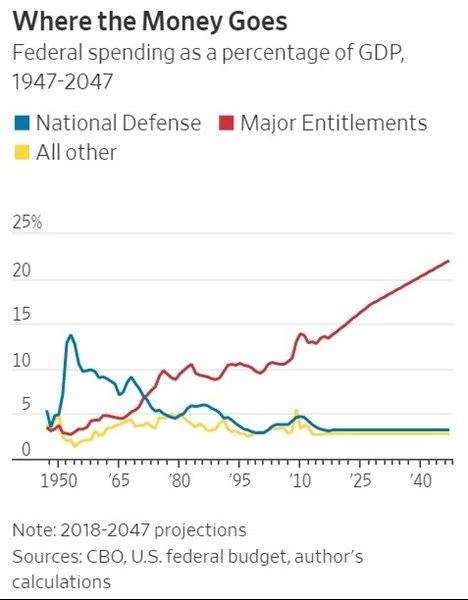
"…the $82 trillion avalanche of Social Security and Medicare deficits that will come over the next three decades elicits a collective shrug. Future historians—and taxpayers—are unlikely to forgive our casual indifference to what has been called “the most predictable economic crisis in history.” …Between 2008 and 2030, 74 million Americans born between 1946 and 1964—or 10,000 per day—will retire into Social Security and Medicare. And despite trust-fund accounting games, all spending will be financed by current taxpayers. That was all right in 1960, when five workers supported each retiree. The ratio has since fallen below three-to-one today, on its way to two-to-one by the 2030s. …These demographic challenges are worsened by rising health-care costs and repeated benefit expansions from Congress. Today’s typical retiring couple has paid $140,000 into Medicare and will receive $420,000 in benefits (in net present value)"
https://fee.org/articles/entitlements-the-most-predictable-economic-crisis-in-history/
* hyperinflation (it's easier to devalue the currency than to collect rapacious taxes)
* capital controls (to prevent people from shifting their rapidly devaluing savings to a more stable economy)
* price controls (hyperinflation causes the cost of goods and services to increase rapidly, which causes voters to demand that politicians "do something" about the high prices)
* tax hikes (generally futile, as people just refuse to pay / hide their money when tax rates get too high)
* bank holidays / confiscation (banks are closed or only allow limited withdrawals, to prevent their customers from withdrawing too much of the rapidly deflating currency)
What can you do?
* Move to a country with saner fiscal policy (A list is available here: https://flagtheory.com/tax-free-countries/). Though, when the U.S. government collapses, it will have an impact that will be felt around the globe.
* Invest some of your assets into cryptocurrency (especially private currencies, like Monero and Zcash). While cryptocurrencies have many risks of their own, they're not subject to government imposed hyperinflation, confiscation, capital controls, or many other tactics of governments in decline.
* Invest some of your assets in precious metals like gold and silver.
* Don't expect Social Security or Medicare to pay anything like what they've paid your parents or grandparents.
* Pay off your house. Get out of debt.
* Invest globally, such as through an international smallcap index fund.
* Invest in security measures (crime tends to increase when people are poor and desperate).
"…the $82 trillion avalanche of Social Security and Medicare deficits that will come over the next three decades elicits a collective shrug. Future historians—and taxpayers—are unlikely to forgive our casual indifference to what has been called “the most predictable economic crisis in history.” …Between 2008 and 2030, 74 million Americans born between 1946 and 1964—or 10,000 per day—will retire into Social Security and Medicare. And despite trust-fund accounting games, all spending will be financed by current taxpayers. That was all right in 1960, when five workers supported each retiree. The ratio has since fallen below three-to-one today, on its way to two-to-one by the 2030s. …These demographic challenges are worsened by rising health-care costs and repeated benefit expansions from Congress. Today’s typical retiring couple has paid $140,000 into Medicare and will receive $420,000 in benefits (in net present value)"
https://fee.org/articles/entitlements-the-most-predictable-economic-crisis-in-history/