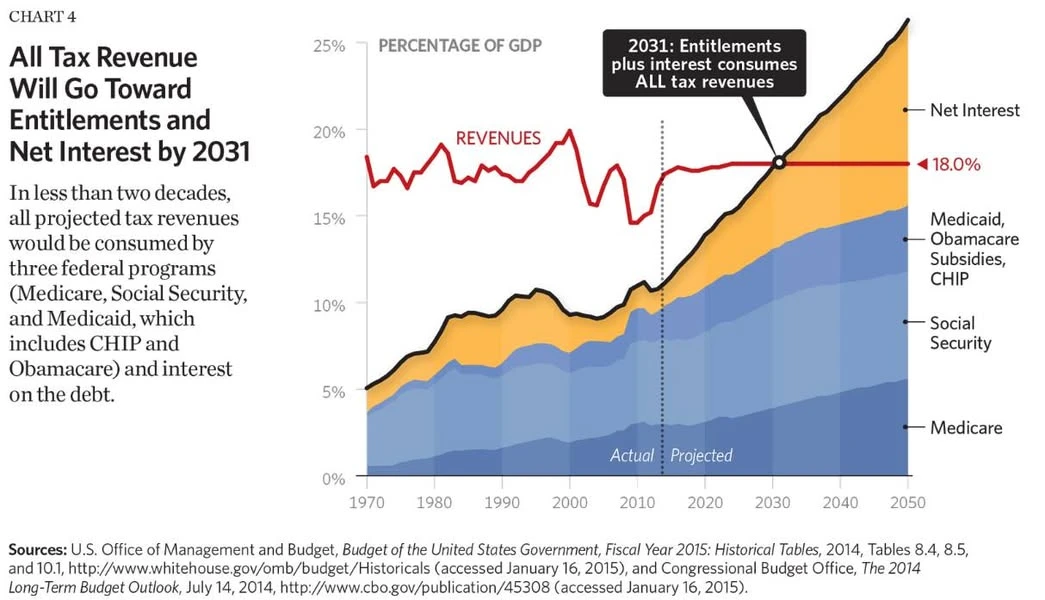
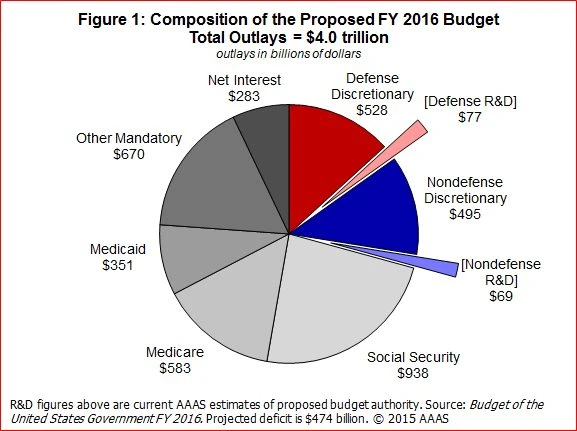
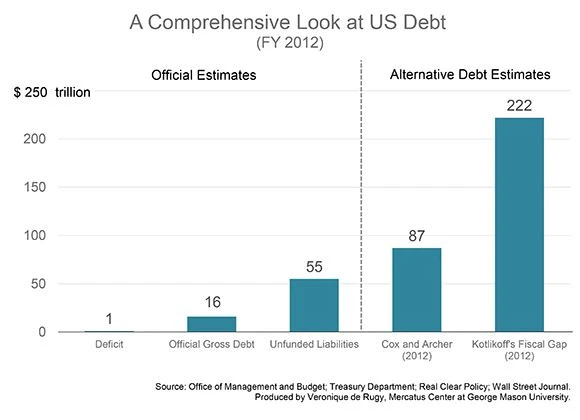
This is one of the reasons I'm bullish about the long-term prospects of cryptocurrencies. I don't think the government can cut benefits nor raise taxes enough to pay for existing liabilities. (The last attempt to shave a mere $5 billion off the _rate of increase_ in spending caused the government to shutdown.)
IMO, the only politically feasible solution will be to massively inflate the currency, to pay for nominal benefits with less valuable dollars. This will create a massive flight to "hard" assets that cannot be devalued by inflation, such as cryptocurrencies.
"...I calculate that the “fiscal gap” — a yardstick of total government indebtedness that I’ve worked on with the economists Alan J. Auerbach and Jagadeesh Gokhale — was $210 trillion last year, up from $205 trillion the previous year. Thus $5 trillion was the true deficit.
The fiscal gap — the difference between our government’s projected financial obligations and the present value of all projected future tax and other receipts — is, effectively, our nation’s credit card bill. Eliminating it, would require an immediate, permanent 59 percent increase in federal tax revenue. An immediate, permanent 38 percent cut in federal spending would also suffice. The longer we wait, the worse the pain. If, for example, we do nothing for 20 years, the requisite federal tax increase would be 70 percent, or the requisite spending cut, 43 percent."
https://www.nytimes.com/2014/08/01/opinion/laurence-kotlikoff-on-fiscal-gap-accounting.html
IMO, the only politically feasible solution will be to massively inflate the currency, to pay for nominal benefits with less valuable dollars. This will create a massive flight to "hard" assets that cannot be devalued by inflation, such as cryptocurrencies.
"...I calculate that the “fiscal gap” — a yardstick of total government indebtedness that I’ve worked on with the economists Alan J. Auerbach and Jagadeesh Gokhale — was $210 trillion last year, up from $205 trillion the previous year. Thus $5 trillion was the true deficit.
The fiscal gap — the difference between our government’s projected financial obligations and the present value of all projected future tax and other receipts — is, effectively, our nation’s credit card bill. Eliminating it, would require an immediate, permanent 59 percent increase in federal tax revenue. An immediate, permanent 38 percent cut in federal spending would also suffice. The longer we wait, the worse the pain. If, for example, we do nothing for 20 years, the requisite federal tax increase would be 70 percent, or the requisite spending cut, 43 percent."
https://www.nytimes.com/2014/08/01/opinion/laurence-kotlikoff-on-fiscal-gap-accounting.html