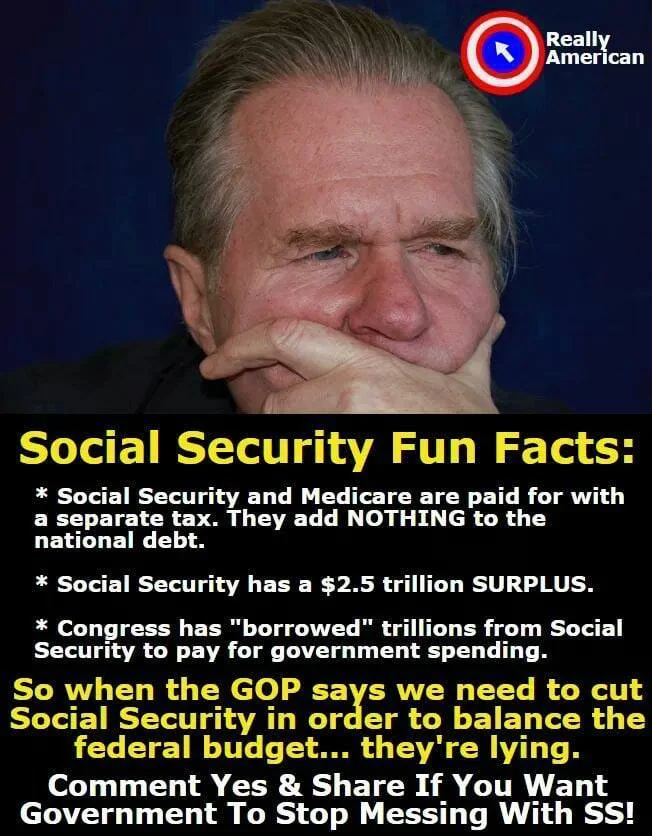
Antony Davies debunks this meme:
Separate tax:
In Helvering v. Davis (1937), the Supreme Court ruled, "The proceeds of both (employee and employer SS) taxes are to be paid into the treasury like other internal revenue generally, and are not earmarked in any way."
http://www.supremelaw.org/decs/helvering/301US619.htm
Surplus:
See Table II on page 14 of the SS annual report. The retirement portion (OASI) is in deficit. The entire program (OASDI) shows a small surplus, but that surplus is only due to interest income. The program is bringing in less money than it pays out.
From page 5 of the report, "Under the intermediate assumptions, the projected hypothetical combined OASI and DI Trust Fund asset reserves become depleted and unable to pay scheduled benefits in full on a timely basis in 2035."
https://www.ssa.gov/OACT/TR/2019/tr2019.pdf
Congress borrowed from SS:
Ironically, SS wouldn't have that interest income if the government hadn't borrowed from it.
...
In response to the claim
"Even with Antony's explanation, SS sure isn't as bad as I was taught."
Antony Davies writes:
"I suggest that it is as bad as you were taught. We're not aware because we've been "slow cooked." You see it if you look back at how the program has had to change to remain solvent. In the 1950s, the SS payroll tax was 2.25%. By the 1960s, it had more than doubled to 5.9%. By the 1980s, it had almost doubled again to 11.4%. Today, of course, it stands at 12.4%, and the Board of Trustees says that it needs to rise to 15.1% if the program is to continue beyond 2036.
So, over the course of 70 years, the Social Security tax has had to increase almost 600% faster than inflation to keep the program solvent. For comparison, over the same period, average college tuition rose 400% faster than inflation. If we believe that the rising cost of tuition is unsustainable, we should be far more concerned about the rising cost of Social Security."
Separate tax:
In Helvering v. Davis (1937), the Supreme Court ruled, "The proceeds of both (employee and employer SS) taxes are to be paid into the treasury like other internal revenue generally, and are not earmarked in any way."
http://www.supremelaw.org/decs/helvering/301US619.htm
Surplus:
See Table II on page 14 of the SS annual report. The retirement portion (OASI) is in deficit. The entire program (OASDI) shows a small surplus, but that surplus is only due to interest income. The program is bringing in less money than it pays out.
From page 5 of the report, "Under the intermediate assumptions, the projected hypothetical combined OASI and DI Trust Fund asset reserves become depleted and unable to pay scheduled benefits in full on a timely basis in 2035."
https://www.ssa.gov/OACT/TR/2019/tr2019.pdf
Congress borrowed from SS:
Ironically, SS wouldn't have that interest income if the government hadn't borrowed from it.
...
In response to the claim
"Even with Antony's explanation, SS sure isn't as bad as I was taught."
Antony Davies writes:
"I suggest that it is as bad as you were taught. We're not aware because we've been "slow cooked." You see it if you look back at how the program has had to change to remain solvent. In the 1950s, the SS payroll tax was 2.25%. By the 1960s, it had more than doubled to 5.9%. By the 1980s, it had almost doubled again to 11.4%. Today, of course, it stands at 12.4%, and the Board of Trustees says that it needs to rise to 15.1% if the program is to continue beyond 2036.
So, over the course of 70 years, the Social Security tax has had to increase almost 600% faster than inflation to keep the program solvent. For comparison, over the same period, average college tuition rose 400% faster than inflation. If we believe that the rising cost of tuition is unsustainable, we should be far more concerned about the rising cost of Social Security."