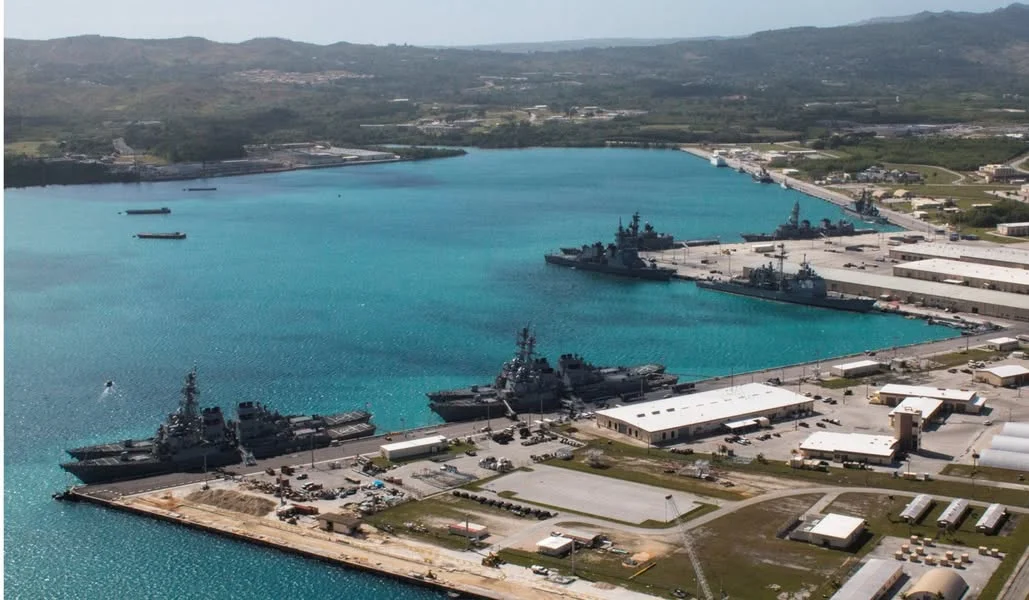
China’s most advanced research vessel recently spent nearly a month operating in the backyard of the largest US military base in Asia-Pacific waters “under the nose of US spy planes”, according to a marine scientist leading the expedition.
The Kexue oceanographic ship had regular low flyovers from US Navy P3-Orion surveillance aircraft while investigating a seamount southeast of Guam between August 5 and September 5, the researcher told the South China Morning
Guam is home port to the US’s fast-attack nuclear submarines that operate in the South China Sea and from the US naval base that is combined with Andersen Air Force Base. From this outpost, B-2 stealth bombers can quickly reach potential conflict areas such as the Korean Peninsula.
Xu Kuidong, a lead researcher with the mission who is affiliated with the Institute of Oceanology, Chinese Academy of Sciences in Qingdao, Shandong, said the scientists on board were “well aware” of the area’s sensitivity.
“It is all about the Second Island Chain,” he said, referring to a series of archipelagos that stretches from the eastern coast of Japan to the Bonin islands, to the Mariana islands, to Guam and the island country of Palau.
The US-controlled islands initially served as a second line of defence against communist countries in East Asia during the cold war. Today they are regarded as a major constraint on China’s rapidly expanding marine power and influence in the Pacific Ocean.
Caroline seamount is a large table-top mountain rising more than 3,000 metres from the sea floor, with its highest peaks fewer than 30 metres below the surface. Caroline has irregular landscapes such as sheer cliffs and holes which generate powerful, unexpected turbulence that can threaten submarines.
The researchers found that the seamount used to be an island with a high point 1,700 metres above sea level. The cliffs and holes were created by tidal wave erosion.
The team’s findings would be shared with the Chinese military and other interest groups in government, Xu said.
Chinese scientists discover new family of barnacles during expedition to Okinawa
“There are many efforts going on to breach the Second Island Chain, this is part of them,” he said.
On a steep mountain slope more than 1,200 metres below the surface, one of Kexue’s underwater drones discovered what is likely the planet’s longest living organism.
It was a black coral about 1.6 metres tall – the height of an average Chinese woman – with “arms” extending nearly three metres across.
Another similar-sized black coral found by US scientists in warmer and shallower waters near Hawaii has been shown to be 4,265 years old.
The Caroline specimen was likely even older. Although it was about the same size as the Hawaiian sample, it lived at a greater depth and had a relatively poor food supply, so it would have taken longer to grow, Xu said.
Since the coral was dead when it was discovered, scientists used carbon dating to age the sample, he said.
This and other discoveries, including the observation of many creatures with features previously unseen, will be published in a series of papers in international journals, Xu said.
If Beijing can claim South China Sea, US can call Pacific ‘American Sea’, says Clinton in leaked speech
Besides their scientific value, the papers will tell the international community that China meant to “come and play” in this strategic location, he said.
The Caroline seamount is located in the midway between Guam and the Federated States of Micronesia, an island country on the other side of the Second Island Chain.
According to Tom Matelski, a US Army War College Fellow at the Daniel K. Inouye Asia Pacific Centre for Security Studies in Hawaii, China was seeking to build a military base in Micronesia.
Micronesia, with a population of about 110,000, has received a large amount of aid and investment from China since 2003. The money helped build some of the nation’s largest farms, schools, bridges and power plants, as well as the residence for the president and other senior government officials.
Since Micronesia lacked its own military, it had “outsourced” its defence to the US since the end of the second world war. But in 2015 Micronesian lawmakers introduced a resolution to end the exclusive partnership with the US as early as 2018.
Why the US policy on South China Sea only helps China
If the Chinese military got a foothold on a Micronesian island, “the US could potentially lose their access to the strategic lines of communication that connect the Pacific Ocean to the vital traffic of the East and South China Seas”, Matelski wrote in an article published on the website of The Diplomat magazine in February last year.
Possession of portions of the Second Island Chain would give China a “springboard against foreign force projection,” he said.
https://www.scmp.com/news/china/diplomacy-defence/article/2113883/us-spy-planes-kept-eye-chinese-scientists-during
The Kexue oceanographic ship had regular low flyovers from US Navy P3-Orion surveillance aircraft while investigating a seamount southeast of Guam between August 5 and September 5, the researcher told the South China Morning
Guam is home port to the US’s fast-attack nuclear submarines that operate in the South China Sea and from the US naval base that is combined with Andersen Air Force Base. From this outpost, B-2 stealth bombers can quickly reach potential conflict areas such as the Korean Peninsula.
Xu Kuidong, a lead researcher with the mission who is affiliated with the Institute of Oceanology, Chinese Academy of Sciences in Qingdao, Shandong, said the scientists on board were “well aware” of the area’s sensitivity.
“It is all about the Second Island Chain,” he said, referring to a series of archipelagos that stretches from the eastern coast of Japan to the Bonin islands, to the Mariana islands, to Guam and the island country of Palau.
The US-controlled islands initially served as a second line of defence against communist countries in East Asia during the cold war. Today they are regarded as a major constraint on China’s rapidly expanding marine power and influence in the Pacific Ocean.
Caroline seamount is a large table-top mountain rising more than 3,000 metres from the sea floor, with its highest peaks fewer than 30 metres below the surface. Caroline has irregular landscapes such as sheer cliffs and holes which generate powerful, unexpected turbulence that can threaten submarines.
The researchers found that the seamount used to be an island with a high point 1,700 metres above sea level. The cliffs and holes were created by tidal wave erosion.
The team’s findings would be shared with the Chinese military and other interest groups in government, Xu said.
Chinese scientists discover new family of barnacles during expedition to Okinawa
“There are many efforts going on to breach the Second Island Chain, this is part of them,” he said.
On a steep mountain slope more than 1,200 metres below the surface, one of Kexue’s underwater drones discovered what is likely the planet’s longest living organism.
It was a black coral about 1.6 metres tall – the height of an average Chinese woman – with “arms” extending nearly three metres across.
Another similar-sized black coral found by US scientists in warmer and shallower waters near Hawaii has been shown to be 4,265 years old.
The Caroline specimen was likely even older. Although it was about the same size as the Hawaiian sample, it lived at a greater depth and had a relatively poor food supply, so it would have taken longer to grow, Xu said.
Since the coral was dead when it was discovered, scientists used carbon dating to age the sample, he said.
This and other discoveries, including the observation of many creatures with features previously unseen, will be published in a series of papers in international journals, Xu said.
If Beijing can claim South China Sea, US can call Pacific ‘American Sea’, says Clinton in leaked speech
Besides their scientific value, the papers will tell the international community that China meant to “come and play” in this strategic location, he said.
The Caroline seamount is located in the midway between Guam and the Federated States of Micronesia, an island country on the other side of the Second Island Chain.
According to Tom Matelski, a US Army War College Fellow at the Daniel K. Inouye Asia Pacific Centre for Security Studies in Hawaii, China was seeking to build a military base in Micronesia.
Micronesia, with a population of about 110,000, has received a large amount of aid and investment from China since 2003. The money helped build some of the nation’s largest farms, schools, bridges and power plants, as well as the residence for the president and other senior government officials.
Since Micronesia lacked its own military, it had “outsourced” its defence to the US since the end of the second world war. But in 2015 Micronesian lawmakers introduced a resolution to end the exclusive partnership with the US as early as 2018.
Why the US policy on South China Sea only helps China
If the Chinese military got a foothold on a Micronesian island, “the US could potentially lose their access to the strategic lines of communication that connect the Pacific Ocean to the vital traffic of the East and South China Seas”, Matelski wrote in an article published on the website of The Diplomat magazine in February last year.
Possession of portions of the Second Island Chain would give China a “springboard against foreign force projection,” he said.
https://www.scmp.com/news/china/diplomacy-defence/article/2113883/us-spy-planes-kept-eye-chinese-scientists-during