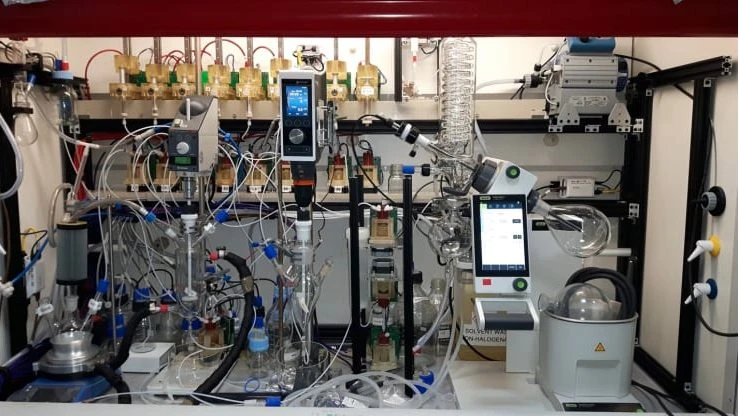
"In June, the U.S. government purchased the vast majority of world’s supply of remdesivir—a FDA-approved antiviral treatment for Covid-19—for July through September. Gilead, the company that makes the compound, recently announced that it would meet international demand by the end of October. Yet all along, digital instructions for whipping up a batch of the nearly 400-atom molecule at the push of a button have been sitting on Github, an online software repository, freely available to anyone with the hardware needed to execute the chemical “program.”
A dozen such chemical computers or “chemputers” sit in the University of Glasgow lab of Lee Cronin, the chemist who designed the bird’s nest of tubing, pumps, and flasks, and wrote the remdesivir code that runs on it. He’s spent years dreaming of a future where researchers can distribute and produce molecules as easily as they email and print PDFs, making not being able to order a drug as archaic as not being able to locate a modern text.
“If we have standard way of discovering molecules, making molecules, and then manufacturing them, suddenly nothing goes out of print,” he says. “It’s like an ebook reader for chemistry.”"
https://www.cnbc.com/2020/10/24/how-a-digital-breakthrough-could-revolutionize-drug-industry.html
A dozen such chemical computers or “chemputers” sit in the University of Glasgow lab of Lee Cronin, the chemist who designed the bird’s nest of tubing, pumps, and flasks, and wrote the remdesivir code that runs on it. He’s spent years dreaming of a future where researchers can distribute and produce molecules as easily as they email and print PDFs, making not being able to order a drug as archaic as not being able to locate a modern text.
“If we have standard way of discovering molecules, making molecules, and then manufacturing them, suddenly nothing goes out of print,” he says. “It’s like an ebook reader for chemistry.”"
https://www.cnbc.com/2020/10/24/how-a-digital-breakthrough-could-revolutionize-drug-industry.html