People who argue for increasing government control over healthcare (aka socialized medicine) often claim that the pathologies of the US healthcare system are due to the "free market".
Yet the US healthcare system is no free market. Not even close.
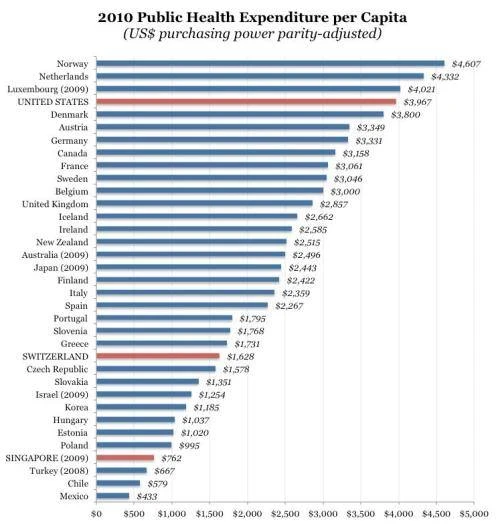
In terms of government spending, the US government spends more on healthcare per capita than all but a few countries. (Circa 2010, only Norway, Netherlands, and Luxemborg governments spent more):
https://danieljmitchell.wordpress.com/2013/02/23/which-nation-has-the-most-per-capita-government-spending-on-healthcare-france-italy-the-united-states-sweden-canada-greece-or-the-united-kingdom/
The US government directly controls more than 60% of all healthcare spending in the US, and indirectly controls much of the rest via a vast panoply of regulations such as:
* Licensure laws that let the medical cartels jack up their salaries by severely restricting new entrants to the medical labor market
* Certificate of Need laws that let existing hospitals block the construction of new hospitals
* FDA regulations which add hundreds of millions of dollars in costs to new drug development
This is just a few of the ways that government increases costs and decreases access to care. For a more detailed list, see this post:
https://www.facebook.com/archerships/posts/10159350297200312
In addition, there's widespread agreement on the left that Trump is a narcissistic madman.
Therefore, I find it puzzling that Trump's reign does not appear to have diminished the left's enthusiasm for giving the government more money and increasing the power it has over our lives.
Shouldn't we be _decreasing_ the amount of money and power the government controls, so that the next Trump can do less damage?
It doesn't have to be a choice between a government monopoly controlled by a madman or an unholy union of corporate rentseekers and their paternalistic government cronies.
Although it's not widely known, there's a large amount of evidence to support the efficacy of free market healthcare,
For example, India's government spends very little on healthcare for its citizens, about 2% of GDP. As a result, most Indians have to pay for healthcare out of pocket. India's population is also very poor, so they can't afford expensive healthcare.
Yet, Indian medical entrepreneurs have risen to the task. For example, Narayana Health, led by surgeon Devi Shetty, has driven the cost of heart surgeries in India to 2-5% of the cost of similar surgeries in the US.
As of 2015, 12 percent of all heart surgeries in India were performed by Narayana doctors, via network of 32 hospitals in 20 locations throughout India. You can read more about how Devi Shetty and other Indian healthcare entrepreneurs deliver high quality care at a very low cost here:
https://hbr.org/2018/06/is-this-the-hospital-that-will-finally-push-the-expensive-u-s-health-care-system-to-innovate
And it's not just Indian entrepreneurs who are proving the market can deliver better care at a lower cost--listen to this interview with Keith Smith, the founder of the Surgery Center of Oklahoma. His hospital offers low cost, transparent pricing, and quality service:
https://www.econtalk.org/keith-smith-on-free-market-health-care/
Of course, I don't expect the socialists and paternalists to be convinced. But maybe they would be willing to allow a little experimentation?
For example, there was no testing to see if FDA regulations would do more good than harm prior to forcing them onto the entire country. Therefore, how about we lift FDA controls from a single, small state? New Hampshire maybe. Or Wyoming.
If FDA supporters are correct, we should see a sharp decline in the health of the free state citizens relative to the citizens of other states, as they go wild taking unapproved meds and undergoing unproven medical procedures.
On the other hand, if there's no change or an improvement, then wouldn't that suggest that FDA regulations are at best useless, or at worst, actively causing harm? In which case, maybe it should be abolished? Or at least, other states should be allowed to opt out as well.
Yet the US healthcare system is no free market. Not even close.
In terms of government spending, the US government spends more on healthcare per capita than all but a few countries. (Circa 2010, only Norway, Netherlands, and Luxemborg governments spent more):
https://danieljmitchell.wordpress.com/2013/02/23/which-nation-has-the-most-per-capita-government-spending-on-healthcare-france-italy-the-united-states-sweden-canada-greece-or-the-united-kingdom/
The US government directly controls more than 60% of all healthcare spending in the US, and indirectly controls much of the rest via a vast panoply of regulations such as:
* Licensure laws that let the medical cartels jack up their salaries by severely restricting new entrants to the medical labor market
* Certificate of Need laws that let existing hospitals block the construction of new hospitals
* FDA regulations which add hundreds of millions of dollars in costs to new drug development
This is just a few of the ways that government increases costs and decreases access to care. For a more detailed list, see this post:
https://www.facebook.com/archerships/posts/10159350297200312
In addition, there's widespread agreement on the left that Trump is a narcissistic madman.
Therefore, I find it puzzling that Trump's reign does not appear to have diminished the left's enthusiasm for giving the government more money and increasing the power it has over our lives.
Shouldn't we be _decreasing_ the amount of money and power the government controls, so that the next Trump can do less damage?
It doesn't have to be a choice between a government monopoly controlled by a madman or an unholy union of corporate rentseekers and their paternalistic government cronies.
Although it's not widely known, there's a large amount of evidence to support the efficacy of free market healthcare,
For example, India's government spends very little on healthcare for its citizens, about 2% of GDP. As a result, most Indians have to pay for healthcare out of pocket. India's population is also very poor, so they can't afford expensive healthcare.
Yet, Indian medical entrepreneurs have risen to the task. For example, Narayana Health, led by surgeon Devi Shetty, has driven the cost of heart surgeries in India to 2-5% of the cost of similar surgeries in the US.
As of 2015, 12 percent of all heart surgeries in India were performed by Narayana doctors, via network of 32 hospitals in 20 locations throughout India. You can read more about how Devi Shetty and other Indian healthcare entrepreneurs deliver high quality care at a very low cost here:
https://hbr.org/2018/06/is-this-the-hospital-that-will-finally-push-the-expensive-u-s-health-care-system-to-innovate
And it's not just Indian entrepreneurs who are proving the market can deliver better care at a lower cost--listen to this interview with Keith Smith, the founder of the Surgery Center of Oklahoma. His hospital offers low cost, transparent pricing, and quality service:
https://www.econtalk.org/keith-smith-on-free-market-health-care/
Of course, I don't expect the socialists and paternalists to be convinced. But maybe they would be willing to allow a little experimentation?
For example, there was no testing to see if FDA regulations would do more good than harm prior to forcing them onto the entire country. Therefore, how about we lift FDA controls from a single, small state? New Hampshire maybe. Or Wyoming.
If FDA supporters are correct, we should see a sharp decline in the health of the free state citizens relative to the citizens of other states, as they go wild taking unapproved meds and undergoing unproven medical procedures.
On the other hand, if there's no change or an improvement, then wouldn't that suggest that FDA regulations are at best useless, or at worst, actively causing harm? In which case, maybe it should be abolished? Or at least, other states should be allowed to opt out as well.