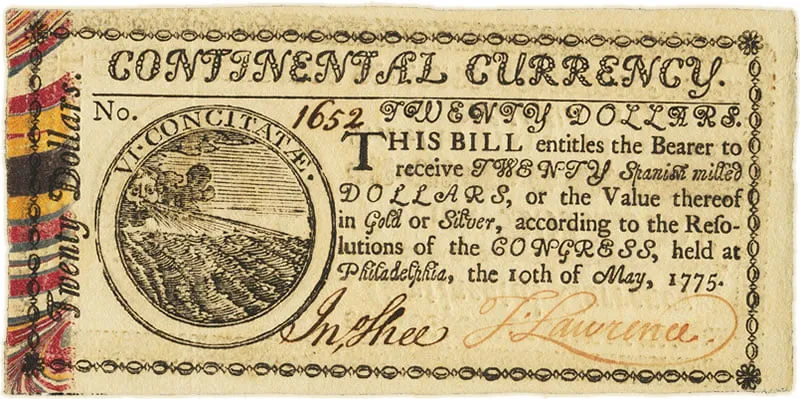
"General Putnam decreed that every one refusing to accept continentals at par would have his goods seized and be imprisoned. The Council of Safety of Pennsylvania, functioning as an executive and judicial body throughout the Revolution, was particularly zealous in trying to outlaw inflation. The Council decreed that any violator of these control laws was a dangerous member of society; that the penalty for first offense would be the seizure of the goods and a heavy fine, and for the second offense would be exile from the state. Yet, this too proved ineffectual in stopping the depreciation and price rise.
Price control, particularly in Pennsylvania and New England, led to acute shortages and widespread violations. Self-appointed committees of citizens in New England looted stores at will, selling the goods from the shelves at fixed prices. All the while, owners were accused of conspiracy to raise prices and charged with being secret Tories, speculators, and enemies of the country.
Informed that a cargo of salt had been "monopolized" and that its price had been increased as a result, the Council of Safety of Pennsylvania seized the salt and ordered it sold at a low price. From then until the end of the war, salt was almost unobtainable in Pennsylvania, because merchants were unwilling to ship salt to Pennsylvania where salt cargoes were in danger of arbitrary seizure. The Council also authorized the Justices of the Peace to seize property if they were informed that any person held more goods than he needed for his personal use.
The Rhode Island State government decreed that if some people were in want and others were deemed to have too much wealth, the Justices of the Peace might order the constables to break open the houses of the "haves" and supply the "have nots" with the goods at lawful prices. (The state was to pocket the proceeds.)
The price control laws could not stem the tide of rising prices. Statesman John Adams reasoned that the laws actually raised prices, since they created a scarcity of goods.
But this experience, instead of leading to repeal of the laws or the ending of the currency inflation, led to demands for even more stringent enforcement. Connecticut decreed a rationing scheme prohibiting any person from buying more than a stipulated amount of food and other necessities. Purchases could not be made without a license from the state. These licenses were to be granted only to "men of good character and friends of independence." All violators of the control laws were considered to be of bad character, and deprived of their licenses.
An influential citizen of Pennsylvania recommended that a "party of soldiers seize any person accused of depreciating or refusing the Congress currency, .. Let them, immediately after seizing such persons, take an inventory of the person's estate ... and let the person so seized be immediately sent to state prison, there to remain without bail till trial for treason, and let the punishment be equal to the crime." Such proposals evidence the extent of the reign of terror throughout Revolutionary America.
Despite such tyrannical measures adopted during a war for liberty, prices sky-rocketed and the continental became worthless."
https://mises.org/library/not-worth-continental
Price control, particularly in Pennsylvania and New England, led to acute shortages and widespread violations. Self-appointed committees of citizens in New England looted stores at will, selling the goods from the shelves at fixed prices. All the while, owners were accused of conspiracy to raise prices and charged with being secret Tories, speculators, and enemies of the country.
Informed that a cargo of salt had been "monopolized" and that its price had been increased as a result, the Council of Safety of Pennsylvania seized the salt and ordered it sold at a low price. From then until the end of the war, salt was almost unobtainable in Pennsylvania, because merchants were unwilling to ship salt to Pennsylvania where salt cargoes were in danger of arbitrary seizure. The Council also authorized the Justices of the Peace to seize property if they were informed that any person held more goods than he needed for his personal use.
The Rhode Island State government decreed that if some people were in want and others were deemed to have too much wealth, the Justices of the Peace might order the constables to break open the houses of the "haves" and supply the "have nots" with the goods at lawful prices. (The state was to pocket the proceeds.)
The price control laws could not stem the tide of rising prices. Statesman John Adams reasoned that the laws actually raised prices, since they created a scarcity of goods.
But this experience, instead of leading to repeal of the laws or the ending of the currency inflation, led to demands for even more stringent enforcement. Connecticut decreed a rationing scheme prohibiting any person from buying more than a stipulated amount of food and other necessities. Purchases could not be made without a license from the state. These licenses were to be granted only to "men of good character and friends of independence." All violators of the control laws were considered to be of bad character, and deprived of their licenses.
An influential citizen of Pennsylvania recommended that a "party of soldiers seize any person accused of depreciating or refusing the Congress currency, .. Let them, immediately after seizing such persons, take an inventory of the person's estate ... and let the person so seized be immediately sent to state prison, there to remain without bail till trial for treason, and let the punishment be equal to the crime." Such proposals evidence the extent of the reign of terror throughout Revolutionary America.
Despite such tyrannical measures adopted during a war for liberty, prices sky-rocketed and the continental became worthless."
https://mises.org/library/not-worth-continental