Whenever I contemplate a new law, I ask myself "If necessary, would I personally be willing to bludgeon someone to death to enforce this law?" If not, then I don't support the law.
That's because the threat of violent death is ultimately what the state uses to enforce laws.
Of course, most governments don't _start_ with bludgeoning. That's because states typically want obedience, not dead or injured vassals. You can't pay taxes if you're dead. So, states typically escalate the violence in proportion to the resistance they meet. Most laws are enforced with fines, at first, for example.
And since most people want to live in peace, they pay the taxes or fines before any violence is necessary. (Just as many people hand over a bundle of cash to the local mafioso without resistance.)
The fact that there was no overt violence doesn't make the transaction voluntary or consensual, however. If you refuse, if you resist, the more aggressive the enforcement mechanisms become. And if you resist with the same level of violence that state actors visit upon you, you will quickly face death.
There are a lot of goods that I wouldn't bludgeon someone to death to acquire. But I still support them via _voluntary_ means.
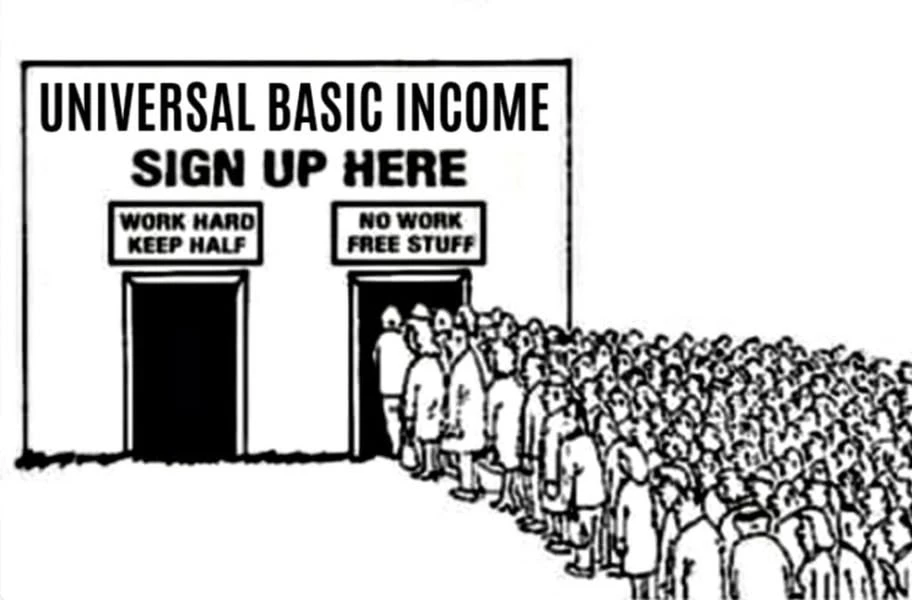
For example, I like the idea of a universal basic income (UBI). My personal material demands are low; I derive most pleasure from intellectual pursuits that are typically free or don't require a lot of money. A UBI would free people like me from drudge work to focus on intellectual pursuits.
But I don't think it's ethical to threaten to bludgeon someone to death unless they cough up money to contribute to my UBI.
Fortunately, there are voluntary alternatives to the UBI. For example, "Mein Grundeinkommen" ("My Basic Income" / MG) is a Berlin based non-profit organisation that crowdfunds and raffles off annual unconditional basic incomes (UBI) of €1,000 per month.
MG started giving away UBIs six years ago. As of 2021, more than 650 UBIs have been granted. More than 1.7 million people have signed up to be able to participate in MG's raffles. More than 130,000 people contribute monthly to keep MG going.
https://www.mein-grundeinkommen.de/infos/in-english
By donating to MG the same amount I would pay if UBI's were compulsory, I would achieve roughly the same amount of good. Using conservative estimates of investment income (4% real return), for every $300 K donated, MG could offer a $1000/month UBI indefinitely.
That's because the threat of violent death is ultimately what the state uses to enforce laws.
Of course, most governments don't _start_ with bludgeoning. That's because states typically want obedience, not dead or injured vassals. You can't pay taxes if you're dead. So, states typically escalate the violence in proportion to the resistance they meet. Most laws are enforced with fines, at first, for example.
And since most people want to live in peace, they pay the taxes or fines before any violence is necessary. (Just as many people hand over a bundle of cash to the local mafioso without resistance.)
The fact that there was no overt violence doesn't make the transaction voluntary or consensual, however. If you refuse, if you resist, the more aggressive the enforcement mechanisms become. And if you resist with the same level of violence that state actors visit upon you, you will quickly face death.
There are a lot of goods that I wouldn't bludgeon someone to death to acquire. But I still support them via _voluntary_ means.
For example, I like the idea of a universal basic income (UBI). My personal material demands are low; I derive most pleasure from intellectual pursuits that are typically free or don't require a lot of money. A UBI would free people like me from drudge work to focus on intellectual pursuits.
But I don't think it's ethical to threaten to bludgeon someone to death unless they cough up money to contribute to my UBI.
Fortunately, there are voluntary alternatives to the UBI. For example, "Mein Grundeinkommen" ("My Basic Income" / MG) is a Berlin based non-profit organisation that crowdfunds and raffles off annual unconditional basic incomes (UBI) of €1,000 per month.
MG started giving away UBIs six years ago. As of 2021, more than 650 UBIs have been granted. More than 1.7 million people have signed up to be able to participate in MG's raffles. More than 130,000 people contribute monthly to keep MG going.
https://www.mein-grundeinkommen.de/infos/in-english
By donating to MG the same amount I would pay if UBI's were compulsory, I would achieve roughly the same amount of good. Using conservative estimates of investment income (4% real return), for every $300 K donated, MG could offer a $1000/month UBI indefinitely.