Some of my artist friends are handwringing about the possible effects of AI on their career, and complaining about the use of their art in the AI training sets.
First, what artist doesn't study past artists? Does that mean that their art is no longer original? If I read HR Giger's art books and then create Giger-esque art should I pay royalties to the HR Giger estate?
What if I also looked at Norman Rockwell paintings, and my Giger-esque painting also looks Rockwell-esque? How do we divide up whose estate is "owed" money? Seems ridiculous to me, and impossible to do.
AI's are doing something analogous to the artist studying past artists, but at a much faster, vaster scale.
AI tools will spur the same thing that happened with the invention of recorded music, photography, and photoshop: an explosion of creativity. The average person will be able to create art that would've otherwise been beyond their skill or budget.
And skilled artists will learn to create new kinds of art that would've been otherwise impossible.
Art is not a zero sum game. The demand for art is effectively infinite. As artistic creation becomes less expensive, markets will open up that were otherwise cost-prohibitive.
Generative VR, for example, will require vast quantities of AI generated art. Imagine that instead of a history book, you could jack into a photo-realistic VR world populated with AI emulated historical figures (based on the known historical documents, paintings, letters, etc). Watch with a God's eye view of an AI-generated battle of Gettysburg, or play along as one of the soldiers.
New kinds of jobs will arise, like prompt designer, AI trainer, and hand editor. Yet even old school techniques will continue on; photography didn't destroy painting as a career. Recorded music didn't destroy live performances. People value the "human" touch, flaws and all.
IMO, we should view the rise of AI-art with excitement, not fear. We will become as gods: speak the right incantation, and our AI golems will create the worlds we desire.
-----
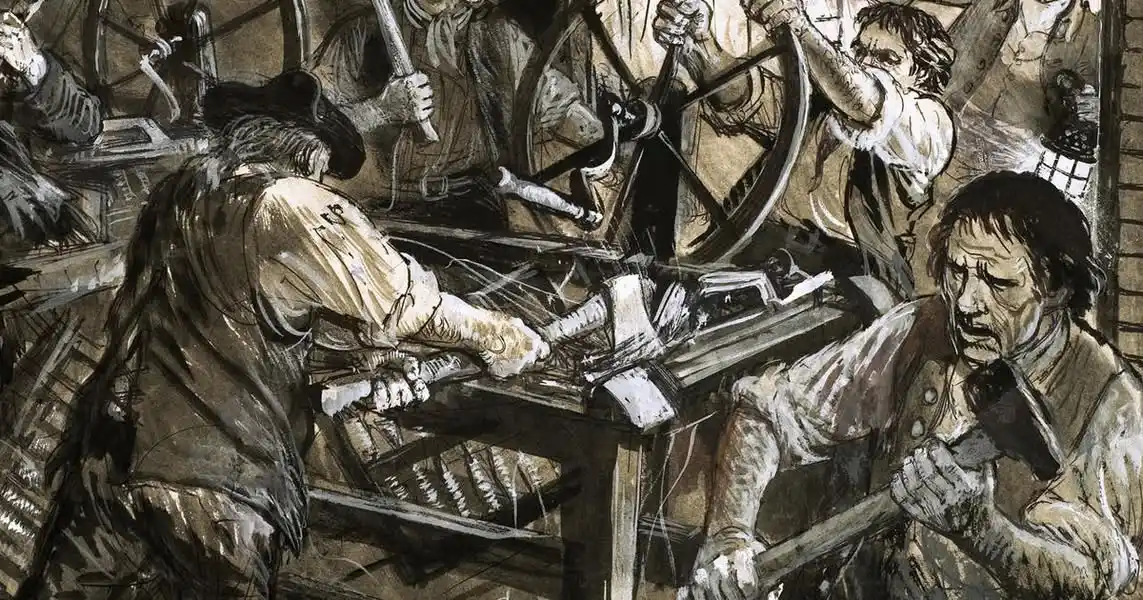
Illustration of Luddites destroying machines in an English textile factory in the early 19th century by Cecil Langley Doughty (1974).
First, what artist doesn't study past artists? Does that mean that their art is no longer original? If I read HR Giger's art books and then create Giger-esque art should I pay royalties to the HR Giger estate?
What if I also looked at Norman Rockwell paintings, and my Giger-esque painting also looks Rockwell-esque? How do we divide up whose estate is "owed" money? Seems ridiculous to me, and impossible to do.
AI's are doing something analogous to the artist studying past artists, but at a much faster, vaster scale.
AI tools will spur the same thing that happened with the invention of recorded music, photography, and photoshop: an explosion of creativity. The average person will be able to create art that would've otherwise been beyond their skill or budget.
And skilled artists will learn to create new kinds of art that would've been otherwise impossible.
Art is not a zero sum game. The demand for art is effectively infinite. As artistic creation becomes less expensive, markets will open up that were otherwise cost-prohibitive.
Generative VR, for example, will require vast quantities of AI generated art. Imagine that instead of a history book, you could jack into a photo-realistic VR world populated with AI emulated historical figures (based on the known historical documents, paintings, letters, etc). Watch with a God's eye view of an AI-generated battle of Gettysburg, or play along as one of the soldiers.
New kinds of jobs will arise, like prompt designer, AI trainer, and hand editor. Yet even old school techniques will continue on; photography didn't destroy painting as a career. Recorded music didn't destroy live performances. People value the "human" touch, flaws and all.
IMO, we should view the rise of AI-art with excitement, not fear. We will become as gods: speak the right incantation, and our AI golems will create the worlds we desire.
-----
Illustration of Luddites destroying machines in an English textile factory in the early 19th century by Cecil Langley Doughty (1974).