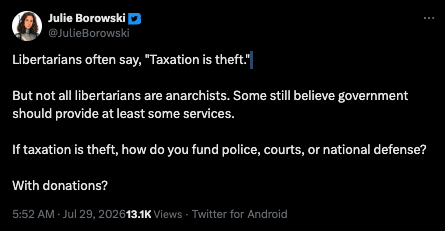
Julie Borowski asks:
“Libertarians often say, ‘Taxation is theft.’
But not all libertarians are anarchists. Some still believe government should provide at least some services.
If taxation is theft, how do you fund police, courts, or national defense?
With donations?“[1]
Prior to the fall of the Soviet Union, the people who lived under communism might have asked a similar question:
“In the absence of government, people will still require food.
If taxation is theft, how will we fund the farming and distribution of food?
With donations?”
But the retort is obvious, right?
You will buy food from privately owned groceries that offer food as one of their products.
It is the same with the other services you discuss.
If you want a cop to protect your property from theft, you look for companies that offer cop services.
Maybe you look at reviews. Maybe you see if they have certifications from respected cop quality assurance orgs, like the LEO Ratings Agency, which tracks reports of excessive force, efficacy, and friendliness of cop companies.
Once you find a cop company you like, you hire them for a fixed monthly or annual fee.
In return, they patrol your property and watch for would-be thieves and criminals.
If someone tries to steal from you, or assault you, they stop and arrest them. (Private citizens are allowed to arrest people, you may recall.)
If you rent a space in a private city like Ciudad Morazan,[2] such services might be part of a package that includes patrolling your property or dispute resolution or defense.[3]
But, you may ask, what if the providers of these services themselves threaten you with violence if you don’t agree to pay for their services?
For the answer, let’s look to the answer to a related question: what if your neighborhood farmer threatens to kill you if you don’t buy his food?
What if he threatens to kill you unless you work on his farm for free?
Remember that, at one time, farmers were allowed to enslave people without fear of arrest or prosecution.
But chattel slavery is rare in the world today.
That is because most people don’t like slavery. They don’t want to be slaves, nor do they want to help farmers enslave others. In fact, people who try to enslave others today are themselves treated as criminals.
If a farmer today claimed that there would be no food unless he were allowed to enslave you, wouldn’t you laugh in his face?
Why shouldn’t that also be the response when a would-be cop claims that you would have no protection if you weren’t forced to buy his services?
While full-blown slavery is no longer culturally accepted in most of the world, partial government slavery is still accepted almost everywhere.[4]
But just as we can change the culture to make full slavery verboten, so too can we change the culture to make partial slavery verboten.
Of course, it won’t be easy. It took decades and a civil war to eliminate chattel slavery in the US.
Even today, chattel slavery is still practiced in a few places in the world.
But the first step is to realize that ending government slavery can and should be done.
Unfortunately, opposition to government slavery is still a minority position. Most people in the US and elsewhere still support it. Changing their minds will likely take quite a bit of time.
However, we don’t need to persuade everyone. We can carve out a few spaces free of government slavery, provided that we concentrate our forces such that conquering us is not worth the cost.
Call to Action
Here are a few ways to do so:
The Free Nation Project (FNP) proposes to establish a sovereign libertarian nation-state within the US Virgin Islands (USVI). Drawing inspiration from the Free State Project, the FNP aims to recruit a sufficient number of liberty-minded individuals to relocate to the USVI, secure majorities in key governmental positions, declare independence from the United States, and implement a comprehensive pro-liberty legal and regulatory framework. This essay outlines the strategic rationale, logistical requirements, and anticipated policy outcomes of the proposed migration, framing the FNP as a practical pathway to creating what the author describes as “the Switzerland of the Caribbean.”[5]
Seasteading offers another path. As one scholar writes: “This essay considers the implications of the Seasteading Institute upon notions of law and sovereignty and argues that seasteading could make possible the implementation or ordering of polycentric legal systems while providing evidence for the viability of private-property anarchism or anarcho-capitalism, at least in their nascent forms. This essay follows in the wake of Edward P. Stringham’s edition Anarchy and the Law and treats seasteading and polycentric law as concrete realities that lend credence to certain anarchist theories. Polycentric law in particular allows for institutional diversity that enables a multiplicity of rules to coexist and even compete in the open market as well as the marketplace of ideas.”[6]
The Free State Project (FSP) has spent two decades building a liberty-friendly political bloc within New Hampshire. As founder Jason Sorens describes it, the project is a vehicle for “seeding conversation” about libertarian ideas rather than achieving electoral control, and has produced measurable policy gains – tax reduction, school choice, and deregulation – while disavowing utopian ambitions.[7]
Footnotes
Julie Borowski, “Libertarians often say, ‘Taxation is theft’…” Twitter/X, July 29, 2026. https://x.com/JulieBorowski/status/2082434018868330550↩︎
Carl Peterson, “Ciudad Morazan: A Libertarian City Without Any Libertarians.” Charter Cities Institute, April 29, 2024. https://chartercitiesinstitute.org/blog-posts/ciudad-morazan-a-libertarian-city-without-any-libertarians/↩︎
Gustave de Molinari, “Of the Production of Security” (1849). Panarchy.org. https://www.panarchy.org/molinari/security.html – The classic liberal argument that security is a service like any other, best supplied by competitive markets.↩︎
Archer T. Ships, “The case for the International Manumission Society.” Twitter/X, July 29, 2026. https://x.com/archerships/status/2082568575093821583↩︎
Archer T. Ships, “The Free Nation Project.” Substack, 2024. https://archerships.substack.com/p/the-arawa-island-project↩︎
Allen Mendenhall, “My ‘Country’ Lies Over the Ocean: Seasteading and Polycentric Law.” Studies in Emergent Order, 2013. https://www.researchgate.net/publication/256046338_My_Country_Lies_Over_the_Ocean_Seasteading_and_Polycentric_Law↩︎
“Its Founder Reflects on the Free State Project.” NH Business Review, October 2021. https://read.nhbr.com/nh-business-review/2021/10/22/#?article=3886193 | Archived on Arweave: https://arweave.net/1Q0CP30Vz_nEFp5DF3MWo18qhZwP10vrwVVLqLdO98k↩︎
Want to stay in touch? You can reach me in a variety of ways from my Contact page.