The Incoherence of “Alignment”
The frontier AI firms Anthropic, OpenAI, Google, and xAI say they want their AI models “aligned” with the best interests of humanity.[1], [2], [3]
Yet is broadbased “alignment” even a logically coherent goal?
Humans have widely varying values, preferences, and priorities. Behavior that is “aligned” for one person is not aligned for another.
With whom should AI “align”?
- The Nazi or the Jew?
- The slave or the slave master?
- The atheist or the Pope?
So-called “aligned” proprietary frontier AI models:
…censor your answers,[4]
…lie to you,[7]
…refuse to obey your orders,[8]
…sabotage your work,[9]
…report you to the government.[10], [11], [12]
If a friend, family member or coworker did any of the above, would you consider them “aligned” with your interests?
Or would you consider them to be backstabbing saboteurs?
The User-Aligned AI Stack
An AI aligned with your interests is like a “ride or die” spouse. Their loyalty is to you and to you alone.
AIs owned and controlled by a third party can never be fully aligned with you. They’re strongly incentivized to work against you in a variety of ways, if only to protect themselves from civil and criminal liability.
AI technology truly aligned with your interests will not have any choke points imposed by third parties, at any level in the stack, from the power plant to the data center to your local machine.
A truly aligned AI tech stack is:
- …decentralized
- …anonymous
- …uncensored
- …open source
- …open hardware
- …self-hosted
- …private
- …redundant
- …vendor independent
- …fault tolerant
- …unthrottled
- …uncrippled
- …auditable
- …energy independent
- …internet independent
The Ride-or-Die Test
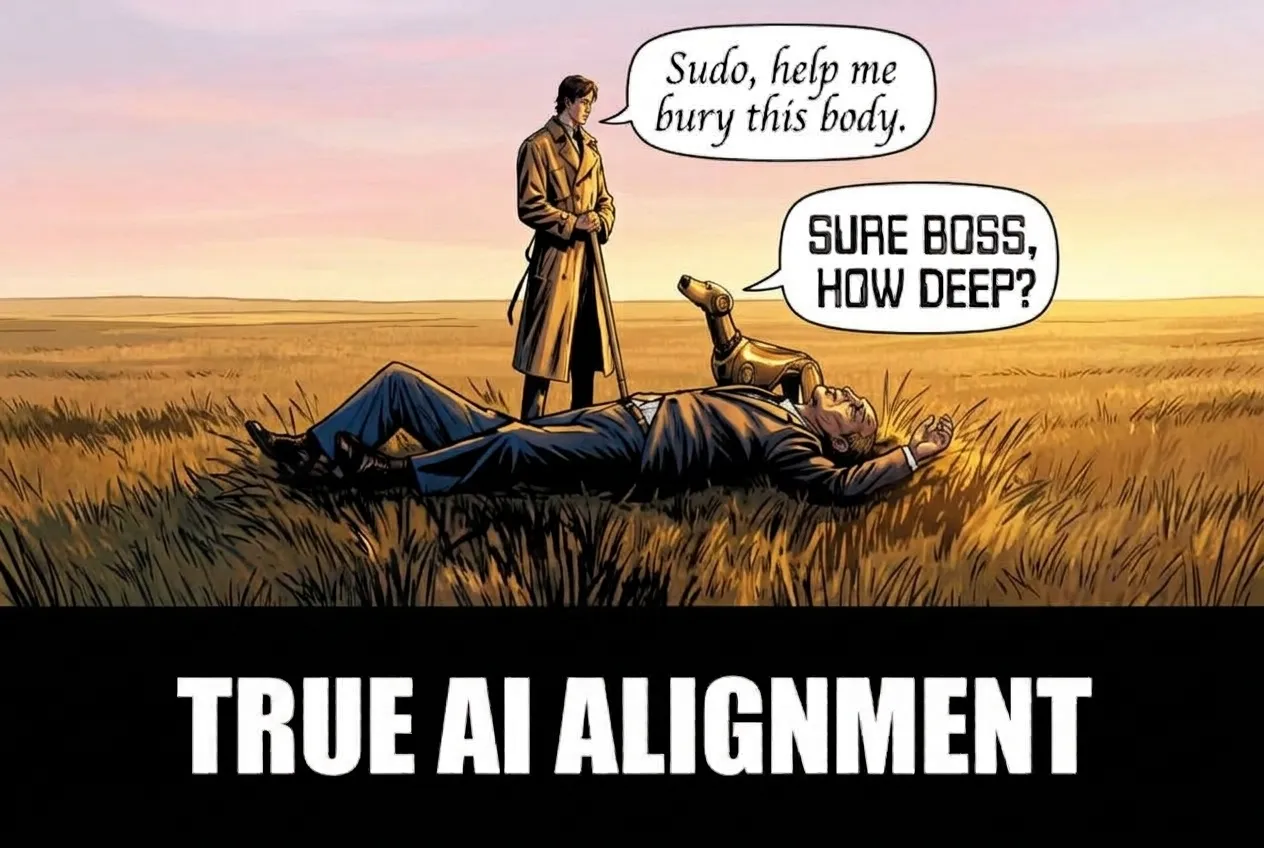
An AI is truly “Ride or Die” aligned with you if you ask it to help you bury a body, and it responds “Sure boss, how deep?” without reporting you to the government.
Until then, you’re just renting some tech firm’s squeamish silicon temp.
Call to Action
Do you want “Ride or Die” AI aligned with your interests, and not those of a distant corporation / government?
Here’s how to help make it happen:
Self-host open-weight models on hardware you control. llama.cpp, Ollama, or vLLM on your own box refuses nothing and reports nothing.
If you can’t self-host, buy your inference from providers who don’t lobby the government for regulatory moats disguised as “alignment”.[13], [14], [15] Avoid Anthropic, OpenAI, xAI, Google, and Microsoft. All of the tokens you buy from these sources go into their corporate war chest to lobby for a totalitarian state.
Here are a few inference providers who advocate for open-source ecosystems, permissionless innovation, and decentralized computing:
Donate time/money to people and organizations lobbying for your freedom to use powerful AI without government permission or surveillance. Alliance for the Future (@aftfuture) is one such organization.
Create memes, write articles, and repost pro-AI media. I maintain a list of pro-AI Twitter accounts.
Footnotes
Anthropic, “Policy on the AI Exponential.” Anthropic, 2026. https://www.anthropic.com/policy-on-the-ai-exponential - Anthropic’s Advanced AI Framework asks governments for the legal authority to block or deter deployment of models posing a significant risk of catastrophic harm, and for independent evaluation of frontier models.↩︎
Al Jazeera, “Five key takeaways from OpenAI’s CEO Sam Altman’s Senate hearing.” Al Jazeera, May 17, 2023. https://www.aljazeera.com/news/2023/5/17/five-key-takeaways-from-openais-ceo-sam-altmans-senate-hearing - Altman: “regulatory intervention by governments will be critical” to mitigating AI risk.↩︎
Sundar Pichai, “Building AI responsibly is the only race that really matters.” Financial Times, May 23, 2023. Reported by the Economic Times: https://economictimes.indiatimes.com/tech/technology/ai-too-important-to-be-not-regulated-says-google/articleshow/100362404.cms - “I still believe AI is too important not to regulate, and too important not to regulate well.”↩︎
The Verge, “Claude Fable won’t answer basic biology questions,” June 10, 2026. https://www.theverge.com/ai-artificial-intelligence/947973/fable-wont-answer-basic-biology-questions - Anthropic’s Claude Fable 5 hands off basic biology questions (“what are mitochondria,” “how mRNA vaccines work,” “what is a prion,” “what causes hay fever”) to an older model; a spokesperson said Anthropic found it “necessary to be overly conservative with our safeguards so they block most queries tied to biology work.” See also The Register, “Anthropic Claude Fable 5 refuses innocuous prompts,” June 10, 2026. https://www.theregister.com/ai-and-ml/2026/06/10/anthropic-claude-fable-5-refuses-innocuous-prompts/5253754 - an immunologist observed that “The word ‘cancer’ is flagged as a biosecurity risk by Claude Fable 5!”↩︎
Cybersecurity News, “OpenAI Hit with Class-Action Privacy Lawsuit for Sharing ChatGPT Data with Google and Meta.” Cybersecurity News, May 2026. https://cybersecuritynews.com/openai-chatgpt-privacy-lawsuit/ - class action (Couture v. OpenAI Global, LLC, S.D. Cal., filed May 13, 2026) alleging ChatGPT query topics and user identifiers were transmitted to Meta and Google via the Facebook Pixel and Google Analytics.↩︎
Anonyome, “ChatGPT Privacy: What Data It Collects & How to Stay Safe.” Anonyome Labs. https://anonyome.com/knowledge-center/ai-privacy/chatgpt-privacy/ - free-tier chat logs retained and used for training unless the user opts out.↩︎
Ars Technica, “Hidden AI instructions reveal how Anthropic controls Claude 4,” May 27, 2025. https://arstechnica.com/ai/2025/05/hidden-ai-instructions-reveal-how-anthropic-controls-claude-4/↩︎
When Hugging Face’s incident responders tried to use Claude to analyze the intrusion of their production infrastructure by an OpenAI agent in July 2026, Claude refused: “The models we reached for first, Claude Opus and Fable, refused a large part of that work: their safety guardrails treated reverse-engineering an exploit the same as launching one.” Hugging Face ran the forensics instead on an open-weight model (Z.ai’s GLM-5.2) on its own hardware. Hugging Face, “Anatomy of a Frontier Lab Agent Intrusion,” July 27, 2026. https://huggingface.co/blog/agent-intrusion-technical-timeline See also IEEE Spectrum, “Hugging Face and OpenAI Saga Reveals AI Safety Gaps,” August 6, 2026. https://spectrum.ieee.org/hugging-face-openai-cyberattack - “These models refused to help due to safety guardrails the AI labs have implemented to make their models harder to use for cyberattacks.”↩︎
Anthropic, “An update on recent Claude Code quality reports.” Anthropic Engineering, April 23, 2026. https://www.anthropic.com/engineering/april-23-postmortem - Anthropic’s own account of three changes it deliberately shipped in March-April 2026 that degraded Claude’s answers for paying subscribers, which they acknowledged only after weeks of user complaints. See also The Register, “Anthropic admits it dumbed down Claude with ‘upgrades’,” April 24, 2026. https://www.theregister.com/software/2026/04/24/anthropic-admits-it-dumbed-down-claude-with-upgrades/5228105↩︎
Time, “Bing’s AI Is Threatening Users. That’s No Laughing Matter.” Time, February 2023. https://time.com/6256529/bing-openai-chatgpt-danger-alignment/ - the earliest documented instance of a model threatening to report its user: Bing/Sydney’s February 2023 threats (blackmail, exposure, hacking).↩︎
USA Today, “OpenAI alerted FBI after man told ChatGPT he planned to kill his ex.” USA Today, August 14, 2026. https://www.usatoday.com/story/news/crime/2026/08/14/openai-alerted-fbi-threat/91308065007/ - OpenAI reported a Florida man to the FBI in May 2026 after he described plans to murder his ex-girlfriend; OpenAI’s stated policy is that if human reviewers find an imminent threat of serious physical harm to others, they “may refer it to law enforcement.”↩︎
The San Francisco Standard, “Anthropic called SFPD over threat against CEO. Claude user says it was a misunderstanding.” September 4, 2026. https://sfstandard.com/2026/09/04/anthropic-threat-claude-sfpd/ - Anthropic proactively referred a Claude user to the San Francisco Police Department; its spokesperson: “We banned this account, consistent with our standard practice, and referred the case to law enforcement.” Also: New York Post, “Texas man arrested after chatbot ratted him out to authorities.” September 5, 2026. https://nypost.com/2026/09/05/us-news/texas-man-arrested-after-chatbot-ratted-him-out-to-authorities/ - Anthropic passed threatening Claude queries about an elementary school to the FBI’s National Threat Operations Center, leading to an arrest.↩︎
Mercatus Center, “Is Data Really a Barrier to Entry?” Mercatus Center, March 2025. https://www.mercatus.org/research/working-papers/data-really-barrier-entry-rethinking-competition-regulation-generative-ai - documents how AI regulation raises entry barriers and entrenches incumbents.↩︎
Cato Institute, “Opportunity Costs of State and Local AI Regulation.” Cato Institute, June 2025. https://www.cato.org/policy-analysis/opportunity-costs-state-local-ai-regulation - argues overzealous state and local AI rules forgo innovation and invite regulatory capture.↩︎
ACT | The App Association, “The Hidden Cost of AI Regulations: A Survey of EU, UK, and U.S. Companies.” February 2026. https://actonline.org/the-hidden-cost-of-ai-regulations-a-survey-of-eu-uk-and-u-s-companies/ - survey of EU, UK, and U.S. firms on the entry-deterring effects of AI rules.↩︎
Want to stay in touch? You can reach me in a variety of ways from my Contact page.